The owner of an online e-bike parts store had no reliable way to tell which Google Ads campaigns were generating sales. When Bavian analyzed the account in September, it uncovered the cause: broken purchase tracking, along with several other overlooked issues.
This is what Bavian found on the first day, and what happened in the five weeks after.
- Business: Online shop for e-bike batteries and bike parts
- Sells: Online nationwide, plus walk-in repairs
- Ad budget: About $900 a week
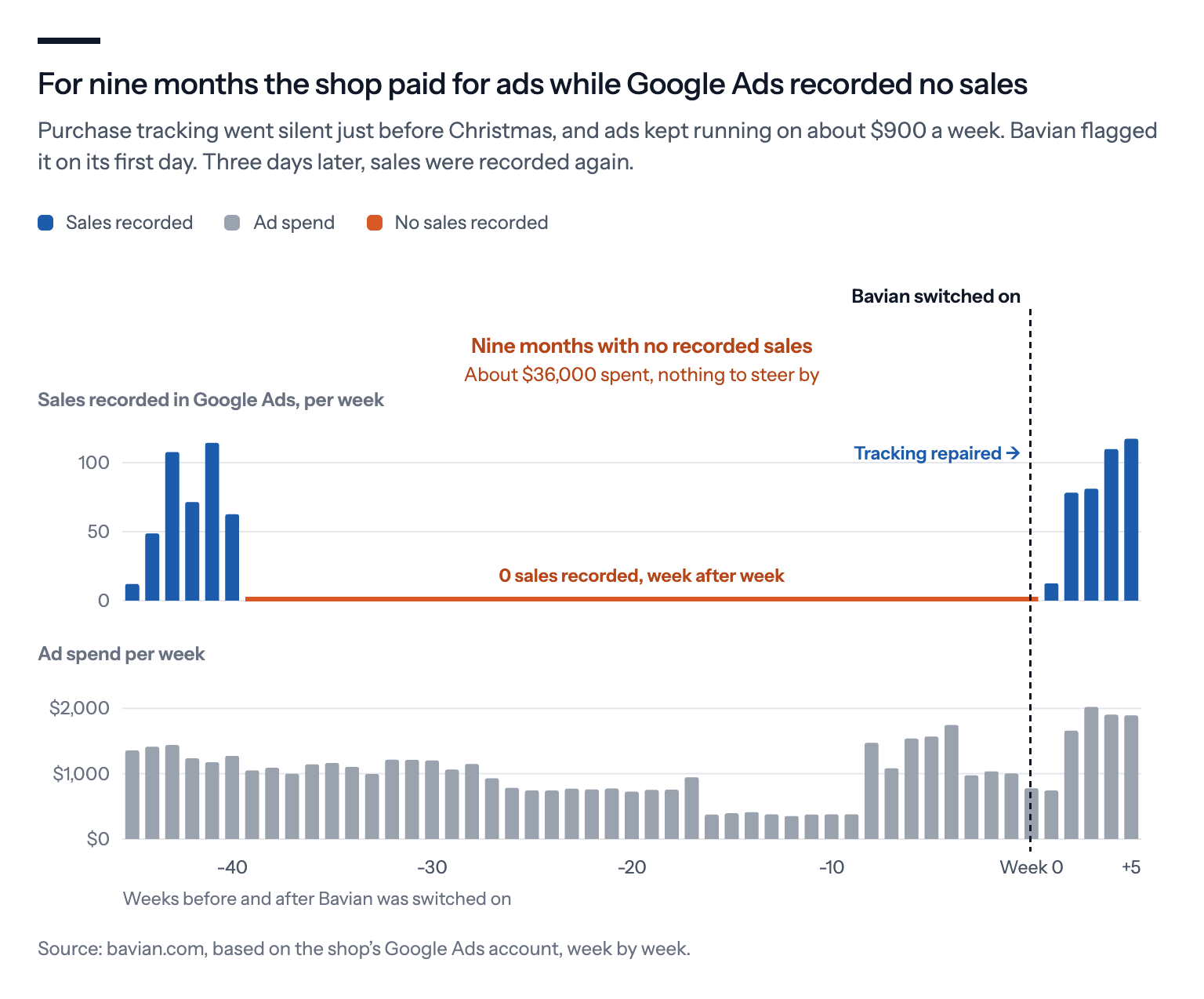
- The problem: Google Ads had recorded no purchases for nine months
- Bavian used: Free analysis, then Autopilot
The short version
- Google Ads had recorded no purchases for nine months while the shop kept spending about $900 a week, about $36,000 in all.
- Bavian flagged the tracking failure on its first day, capped spend and told the owner exactly what needed fixing.
- Three days later, purchases were visible again. The restored data exposed a budget mismatch: the campaign with half the money returned 0.2x, while one given a fifth returned 6.9x.
The problem: nine months without purchase data
The shop sells batteries, brakes, drivetrain parts and accessories for e-bikes and ordinary bikes. Its Google Ads account ran Shopping, Search and Performance Max campaigns on about $900 a week.
Just before Christmas, the purchase tag on the shop's checkout stopped sending sales to Google Ads. The ads didn't depend on it: Google charges for clicks whether or not a sale is reported back, so the campaigns kept running. Orders kept coming in, but Google Ads recorded none of them. Clicks and click prices looked normal, so nothing stood out.
That costs in two ways:
- The owner can't tell which ads earn money.
- Google's bidding has nothing to learn from. It learns from recorded sales, so with none recorded it keeps spending without knowing where the money works.
A marketing consultant described the same pattern in a client's account on a call with Bavian in September 2026: "It just stops tracking … Zero conversions. But all the other numbers are the same."
What Bavian found
When you connect a Google Ads account, Bavian writes an analysis of it before it changes anything. For this shop, the analysis opened with the tracking.
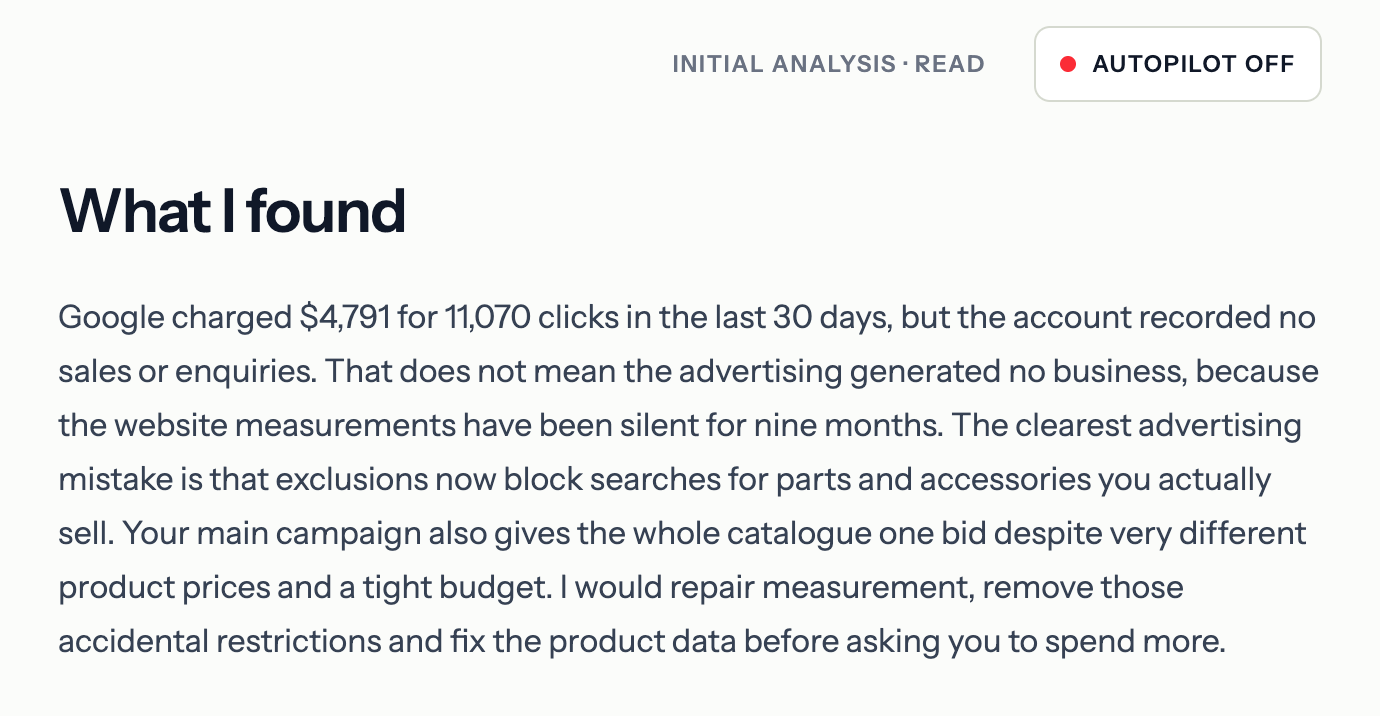
The analysis listed five things in all:
- Purchase tracking silent for nine months. None of the $36,000 spent in that time could be tied to a sale.
- About 300 old exclusions on the main Shopping campaign, some of them blocking searches for parts the shop sells.
- One bid of $1.60 for every product, whether the product cost $40 or $1,480. The same campaign missed three out of four searches it could have shown on, because its budget ran out.
- Five sitelinks pointing to pages that no longer worked.
- Two phone-call actions with fixed placeholder values counted next to purchases. Once tracking came back, calls and sales would have been mixed together.
What happened next
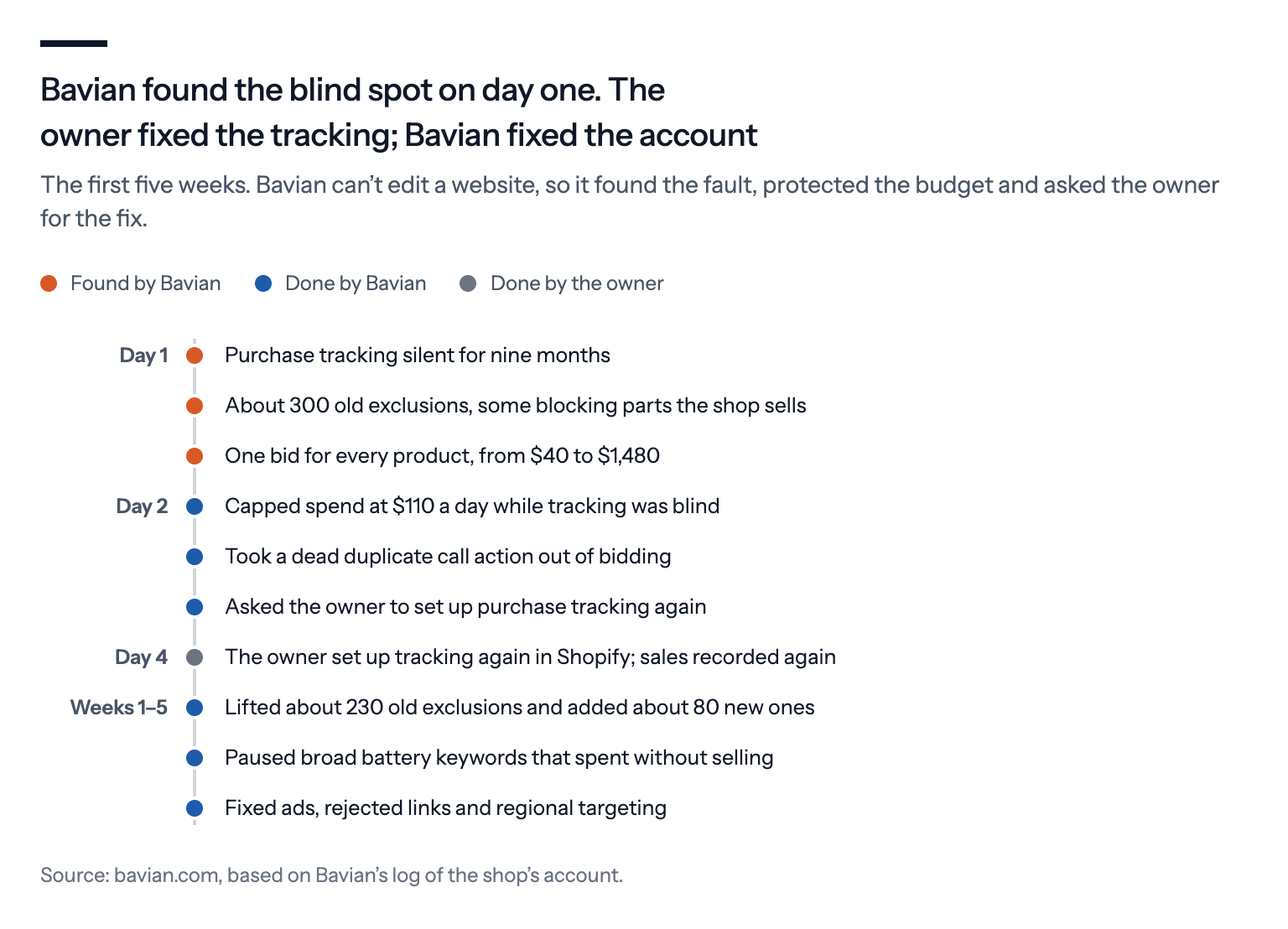
Days 1–2, done by Bavian. Bavian can't edit a shop's website, so it can't repair a tracking tag itself. Instead it:
- capped spend at $110 a day until sales were visible again;
- took a dead duplicate call action out of bidding, and made the other one count once per click;
- told the owner exactly what was needed: set up purchase tracking again, so each order and its value reach Google Ads.
Day 4, done by the owner. The owner replaced the broken tag with the conversion tracking in Shopify's Google & YouTube app, which reports each order and its value to Google Ads. From that day, purchases were recorded again.
Weeks 1–5, done by Bavian. With sales visible, Bavian:
- lifted about 230 old exclusions, including several that blocked the shop's own products, and added about 80 for searches that don't sell;
- paused broad battery keywords that spent without selling;
- rewrote a brand ad that put the shop in the wrong city, and removed unproven "best price on the market" claims;
- removed rejected links, and set three campaigns to show only to people in the country, not abroad.
The result: the account can see again
The first thing the restored data showed was where the money had gone while the account was blind.
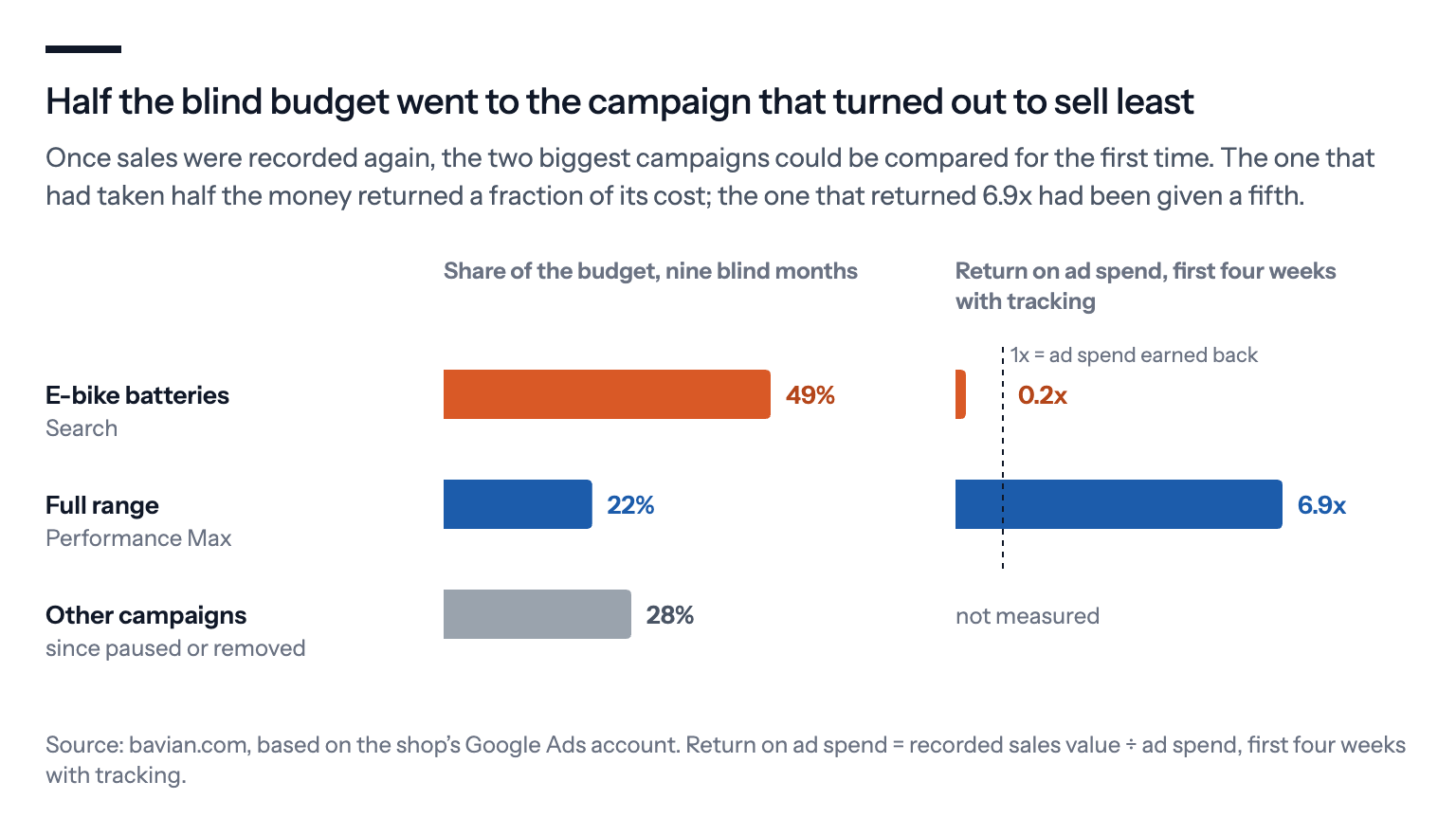
A Search campaign for e-bike batteries had taken half the budget. Once sales were recorded, it returned 0.2x. A Performance Max campaign covering the full range had been given a fifth of the money, and it returned 6.9x. The owner now puts more of the budget where it sells.
With real numbers in front of them, the owner also raised the budget from about $900 to about $1,900 a week. What sales cost during the blind months can't be known. The fair comparison is the last six weeks before tracking stopped, when it still worked: an ad cost per recorded sale of $18.90 then, and $19.40 in the first four weeks after it came back, on a bigger budget.
| Before tracking stopped (6 weeks) | Blind (40 weeks) | Tracking back (first 4 weeks) | |
|---|---|---|---|
| Recorded sales per week | 69.5 | 0 | 96.6 |
| Ad spend per week | $1,315 | $908 | $1,869 |
| Ad cost per sale | $18.90 | — | $19.40 |
| Return on ad spend | 2.0x | — | 2.8x |
With tracking back, the shop recorded 39% more sales a week than before it stopped, at 2.8x return on ad spend.
What this case shows — and what it doesn't
Bavian identified the tracking failure on its first day, protected the budget while the account was blind and told the owner what to fix. Once sales were recorded again, it used the restored data to clean up the account. The website tracking itself was repaired by the owner, who also decided to raise the budget.
The periods are not a controlled before-and-after test. The budget grew, four weeks is a short period, and the new tracking may value orders differently from the old one: the average recorded order rose from about $37 to about $55. The clearest result is that the account went from nine months without usable purchase data to seeing which campaigns earn money again. We'll update the case after Christmas.
Could this be happening in your account?
- Your conversions dropped to zero, or close to it, from one week to the next, while clicks stayed the same.
- You changed your website, a plugin or your cookie banner shortly before.
- Google Ads says your ads don't sell, but your shop keeps getting orders.
Find out if your account is flying blind
Connect your Google Ads account to Bavian for free. Bavian analyses the account and checks whether the conversion data it would optimise against can be trusted. Nothing is changed until you turn on Autopilot. With Autopilot on, Bavian checks the account every day and tells you in plain words when tracking goes quiet.
Get your free analysis on bavian.com · What the free analysis includes
Based on a real Bavian-managed Google Ads account. Identifying details and absolute figures have been adjusted to protect the business and its competitive position.