
This autumn Google moved some Search campaigns into AI Max, switched on automated promotions and announced caps for Search partners and Display. Here's what that means for your account, and what practitioners make of it.
Several of the biggest changes in Google Ads between 1 September and mid-October happened without anyone touching a setting. So an account can work differently today than it did in August, even if nobody has logged in since.
With Q4 underway, it's better to catch these changes now than in late November, so for each one we say what we'd check first.
The short version
- AI Max, Google's bundle of AI features for Search, now runs in Search campaigns that used campaign-level broad match or automatically created assets. Check what each one has switched on.
- Automated promotions have been on by default since 12 October in eligible Search and Performance Max campaigns. Turn them off unless your site's offers are clean and current.
- Channel prioritization can cap Search partners and Display on a best-effort basis. Search campaigns that use Display need a decision before February 2027.
- Budget-limited campaigns with a Target CPA or Target ROAS now aim at their target instead of beating it, after a rollout from 17 to 27 August. smec measured the median cost per click on those with a Target ROAS up 15.8%. Set targets you'd actually accept.
- New AI Max reports show more of what it does. AI Mode still has no reporting line or opt-out.
- Google's data strength uplift is Google grading itself. Self-serve Conversion Lift is the better check if you qualify.
- Retailers: fix feeds, watch Merchant Center's warning about fast-changing prices, and plan the Black Friday–Cyber Monday peak in phases.
AI Max now runs in campaigns that never opted in
From 1 to 30 September, Google moved Search campaigns into AI Max if they used either of two older settings. Campaign-level broad match let every keyword in a campaign match related searches, and automatically created assets let Google write extra ad text.
The only way to avoid the move was to switch those settings off before September. Migrated campaigns can still turn AI Max off, though.
AI Max itself has three parts. Search term matching lets ads show on searches beyond your keywords, text customization has Google write extra headlines and descriptions, and final URL expansion lets Google pick the landing page.
Migrated campaigns got these parts:
| Before September | Search term matching | Text customization | Final URL expansion |
|---|---|---|---|
| Campaign-level broad match | On | Off | Off |
| Automatically created assets | On | On | Off |
Google claims the full suite averages 7% more conversions or conversion value for non-retail advertisers, at a similar cost per conversion or return on ad spend, known as CPA and ROAS. But it measures that against search term matching alone, not against running without AI Max. We haven't seen before-and-after numbers on the migration yet.
Heidi Schwende of WSI warns that a September rise in CPA doesn't prove the migration caused it. Before deciding, she says, match each campaign to its migration date, rule out your own edits, and wait a conversion cycle, which is the usual time from a click to a conversion.
The older smec data she cites shows how unpredictable AI Max can be. Only 22% of campaigns landed close to their original ROAS target, with ROAS anywhere from 42% above baseline to 35% below.
Opinion splits by risk and size.
Tim Jensen, marketing lead at M&T Bank, would turn off text customization and URL expansion for regulated advertisers, because generated copy can drop required disclaimers.
Andrew Lolk of SavvyRevenue sees AI Max acting like broad match. In his view it widens the funnel in large accounts, but in small ones, such as an account with 50 conversions a month, it's an expensive discovery phase.
We'd find each migration date in the change history, then open the AI Max settings. Start with the campaigns that used automatically created assets, because they got two features at once: Google keeps writing ad text for them, and their ads can now show on searches beyond their keywords.
Where wording is regulated, I'd switch text customization off today. Each feature can be turned off separately.
The language setting is gone from Search
Since late September, manual language targeting no longer works for Search campaigns, AI Max for Search, or Performance Max, Google's all-channel campaign type, when its ads run on Google Search. Google matches on the ad's language and the searcher's signals instead.
Google's Ads Liaison, Ginny Marvin, said the system already handles language, and advised making ads and landing pages clearly in the intended language. Regional variants make that harder. Damien, who leads the search advertising team at Dutch agency MarketingConcurrent, suggests splitting ad groups that mix Dutch and Flemish, and recording a baseline for each region now.
Our advice is one language per ad group, with a landing page to match.
Automated promotions have been on by default since 12 October
Since 12 October, Google has been finding promotions on your website and adding them to your ads. It announced the start in an email to advertisers, which Search Engine Roundtable published.
It does this in Search and Performance Max campaigns that use location assets to show your address and carry no promotion assets, the offers you add to an ad yourself. It's on unless you opt out, and the opt-out covers the whole account. Adding a promotion asset of your own keeps that campaign out.
Google describes the feature as picking out high-quality promotions, but in practice it can put offers you never chose into your ads in peak season.
To switch it off, follow Google's steps: Campaigns → Assets → ⋮ More → Account level automated assets → ⋮ More → Advanced settings → Automated promotions: Off. Anyone managing several accounts has to repeat this in each one.
Practitioner reaction was close to one-sided.
Tim Hübler, co-founder of Muhlert Digital, called the opt-out flow a dark pattern, a design that makes saying no deliberately hard. He warned of outdated codes and muddied A/B tests. Menachem Ani called an unchosen promotion "a leak with your logo on it," because codes meant only for new customers can go public and agencies can miss accounts.
Antonio Fernandez of Relevant Audience in Bangkok notes that conditions on an offer, such as a minimum spend or an app-only code, may get lost when it's squeezed into one line. The dissent came under Hübler's post, where Shehzad Sadiq argued that stores with clean promotion pages could gain coverage.
I'd switch it off wherever nobody tightly controls the site's promotion pages, and add promotion assets for the offers you do want shown. If you keep it, check what it generates every week.
That was the pattern of these six weeks: on by default, opt out afterwards.
According to PPC Land, citing Google's email, Shopify stores were likewise switched on from 18 September for checkout inside Gemini and AI Mode, Google's AI search experience, whereas earlier in the year merchants had to opt in. Commenting on Ani's post, Zaheer Rizvi said automation that changes what customers see should be opt-in.
Smart Bidding now bids to your target when budget is tight
Until August, campaigns that were short of budget often beat their bidding targets, but Google now aims them at the target instead, which can make their clicks more expensive.
The change rolled out between 17 and 27 August, but the argument about it ran through September. It concerns campaigns that Google marks "Limited by budget" because their daily budget is too small for all the clicks they could get.
It applies when such a campaign bids toward a Target CPA or a Target ROAS through Smart Bidding, Google's automated bidding, in Search, Shopping, Performance Max, Demand Gen and Travel. Google doesn't adjust your targets for you.
In Google's example, a campaign with a $10 target CPA that has been converting at $5 drifts toward $10.
The clearest data came from Mike Ryan, head of ecommerce insights at smec. In budget-limited Target ROAS campaigns, the median cost per click rose 15.8%, from €0.38 to €0.44, while it fell 13% elsewhere. Impression share, how often the ads showed out of all the times they could have, dropped from 40% to 31% in the limited campaigns.
Before the change, more than half of these campaigns had been beating their ROAS target. smec doesn't say how many campaigns its figures cover, though.
Ryan calls the change healthy. Budget-limited campaigns used to buy up a pool of cheap clicks, well under what their targets allowed, and those clicks are now open to everyone.
Joey Bidner argued on LinkedIn that the size of a budget shouldn't decide performance. On Google's side, Ginny Marvin has argued that a target should mean what it says.
What to do about it is contested too. Ryan says many advertisers raised their ROAS targets defensively, even where nothing changed, while Christian Scharmüller argued in the same discussion for lowering them to win market share.
Keaton Nalle has been adding targets based on what each campaign actually delivers, including to Smart Bidding campaigns that ran without one, and gives the bidding a week or two to relearn.
Commenting on Ryan's post, Kirk Williams asked the question that comes first: how would you even tell whether it hit your account?
That's where we'd start. List the campaigns that are both budget-limited and bidding to a target. Then compare the 30 to 90 days before 17 August with the weeks since, as Ramial Aqeel suggests at PPC Hero.
Where results drifted toward the target, set the target you actually need, moving it no more than 20% per conversion cycle, as Aqeel advises. Where nothing moved, leave it alone.
Channel prioritization caps Search partners and Display, with limits
Channel prioritization lets you limit how much of a campaign's budget goes to Search partners, the other sites that show Google's search ads, and the Display Network of websites and apps. Tal Akabas, the Google product director behind the launch, told reporters at a press briefing that the aim is more predictable spend on channels where it swings.
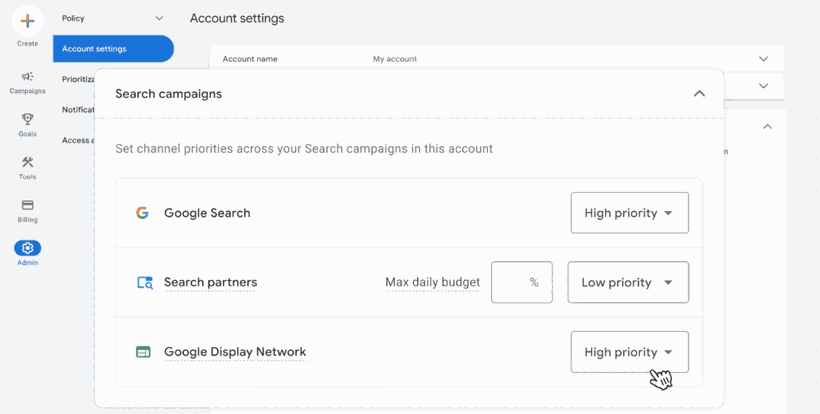
Google announced it on 14 October, and it's rolling out over the coming months. You mark each channel High or Low priority, and High channels are funded first. Low ones can be capped at a percentage of the campaign's average daily budget, and a cap of 0% blocks a channel.
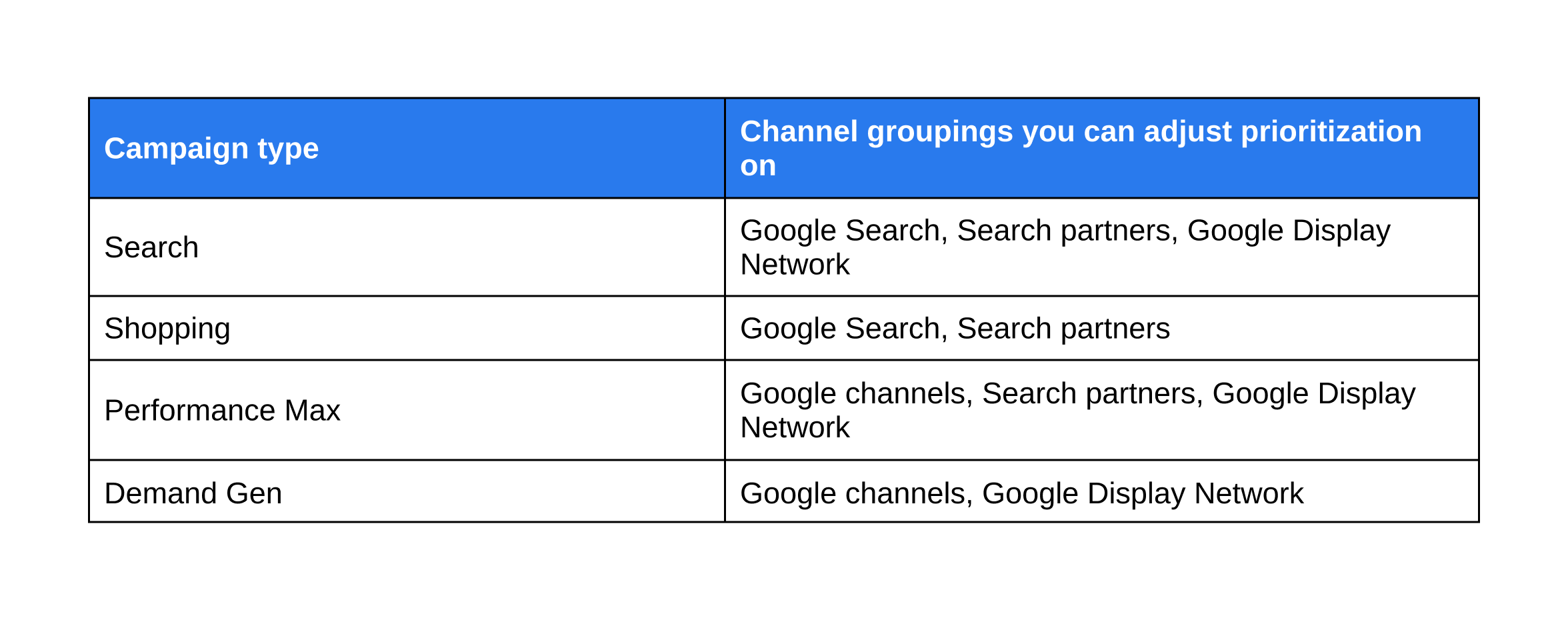
It covers Search, Shopping, Performance Max and Demand Gen, and every channel starts at High.
The limits matter as much as the feature:
- Caps are best effort, so daily spend can go over.
- In Performance Max, Google's own channels stay one bundle: Search, YouTube, Maps, Gmail and Discover. You can cap partners and Display, but not YouTube against Search.
- Demand Gen gets priority only, with no cap.
- You can't set it from a manager account, the account agencies use to run several clients, and support in the API and Google Ads Editor is listed as coming soon.
Search campaigns that also run on the Display Network have until February 2027.
That's when Google moves them to the new system. To keep today's behavior, Google says to set Display to Low priority with a 50% allocation. Display also stops serving on Search campaigns that use Target Impression Share, a bid strategy that aims for a set share of searches.
Early reaction is cautious. Diana Talhelm of ZATO welcomes the controls but repeats Google's point that accounts with accurate conversion data and working Smart Bidding may not need them. She sees them as useful where your customer or sales records show differences between networks that Google Ads reporting misses.
Brooke Osmundson's write-up for Search Engine Journal, based on a Google roundtable, suggests capping partners and Display rather than excluding them, and leaving campaigns that already hit their targets alone.
We'd treat Low with 50% as the do-nothing setting, not as advice.
If Display has proven itself in your own sales data, keep it. If you can't tell, a cap is a cheaper test than switching it off. For now it's set account by account in the interface, so agencies should budget the time.
New AI Max reports help, but AI Mode still has no reporting
Three new tools help advertisers steer AI Max and check what it does, though two of them are still in beta or testing.
AI Brief in more languages. On 23 September, the AI Brief beta, plain-language guidance you give AI Max, added seven languages.
Previews of text customization. Since early October, you can see up to 10 sample headlines and descriptions before you switch it on. Google calls them a representative sample, so read them as a guide to tone and accuracy rather than the exact ads that will serve.
Searches paired with ads. Around 14 October, Natasha Kaurra found the new Search terms and ad combinations report in one of her accounts, and Google appears to be testing it. It pairs each search term with the ad text and landing page shown, and Kaurra welcomed it as a way to catch mismatches between search, ad and page.
AI Mode remains a blind spot.
In early September, Ginny Marvin confirmed a small test in which exact and phrase match keywords, the tighter match types, can show text ads in AI Mode. It covers only searches with explicit, direct intent, which Google hasn't defined.
Search Engine Land also reports a Direct Offer asset in beta, which hands out one-time promo codes in AI Mode but only for campaigns using AI Max or text customization. Yet neither the AI Max reports nor the new channel controls show AI Mode separately, and there's no opt-out.
So run the new report on migrated campaigns when it appears, and preview text customization before you switch it on. If you rely on exact and phrase match for control, assume some of that traffic may reach AI Mode unseen.
Measurement: trust the lift tests more than the uplift metric
A new number in Google Ads credits your data setup with extra conversions, which is easy to mistake for growth.
On 10 September, Google pushed what it calls data strength: how well your first-party data, the customer data you collect yourself, is connected to its tools. Data Manager, Google's tool for connecting that data, now sits inside Google Analytics and Display & Video 360. In the same announcement, Meridian GeoX, Google's free tool for testing ads by comparing regions, became generally available worldwide.
That number is the data strength uplift metric, which estimates the extra conversions your first-party data setup recovers, meaning conversions Google can now count that would otherwise go unmeasured.
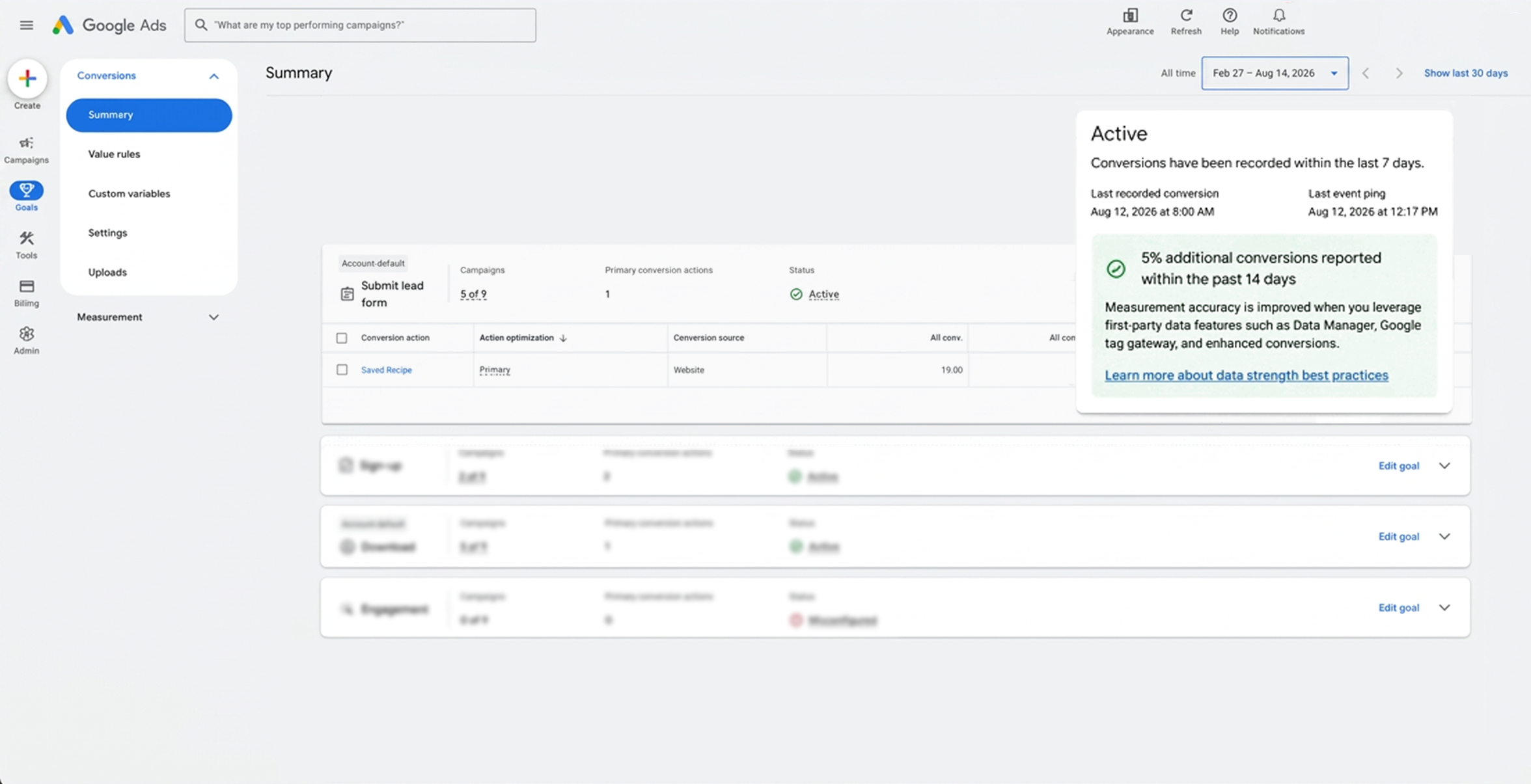
Google claims that advertisers who use Google tag gateway, which routes Google's tracking through your own website's domain, average 14% more conversions. That figure is footnoted to Google's own finance-sector data from 2024–25. For Demand Gen with the same setup, Google claims more than 20%, footnoted to its own data from 3 to 17 June 2026.
PPC Land founder Luis Rijo points out that these figures are self-reported and can't be audited independently, and that Google has published no formula or baseline. He adds that recovered conversions are not incremental sales, meaning extra sales the ads caused.
The tool that can test such claims got easier to reach.
User-based Conversion Lift splits people into a group that sees your ads and one that doesn't, then compares their conversions. It's now self-serve for Search and Performance Max, among others, for accounts with at least 1,000 observed conversions and a study budget of at least US$5,000. Google's page still says not every account has access.
Shane McIntyre of Elevarus advises running a study for at least 14 days with campaign changes frozen. Jordan Fry, CEO of RevAmp, notes that the thresholds exclude most small and mid-size accounts.
Fry also warns that ROAS on your own brand name proves nothing on its own, and Jyll Saskin Gales, a Google Ads coach, shared a case that shows why. In a luxury ecommerce account, paid plus organic brand clicks, at 167, barely beat organic clicks alone a year earlier, at 166. She keeps the campaign anyway, for several reasons, brand defense among them.
Enhanced conversions send scrambled customer details, such as email addresses, so Google can match more conversions to ads. We'd still set them up, because bidding only uses conversions it can see. Just don't read the uplift as growth.
If you clear the lift thresholds, test brand and Performance Max first. If not, there's the geo holdout Nouman Janjua suggested under Fry's post: pause in some regions and compare.
For retailers, Q4 prep starts in Merchant Center
Retailers got two kinds of news this autumn: AI shopping features that mostly start in the US, and Merchant Center rules that apply everywhere.
At Rethink 2026, Google's online event before the holiday season, the announcements for retailers on 16 September leaned into AI shopping. In five markets including the US, Merchant Center now shows your share of voice in AI Mode and in AI Overviews, the AI summaries above Google's results. That's how often your brand shows up there compared with other brands.
In the US, a beta puts Business Agent, an AI chat that answers shoppers' product questions for a brand, inside YouTube ads. And the integration hub for the Universal Commerce Protocol, the open standard behind direct checkout on Google, got checkout updates.
On 15 October, Universal Cart launched in the US on Search and in the Gemini app. It's one cart across retailers, with price and stock alerts and checkout through Google Pay or the merchant's site, and the merchant, not Google, stays the seller.
Outside the US especially, the work that pays this quarter is plainer.
Google's Merchant Center help page now warns that products whose price or availability changes more than about once a day may be disapproved, rather than automatically updated, when Google spots a mismatch. Frequent sale-price changes could trip that rule too, since automatic updates also cover sale prices. The warning arrived in a revision on 27 September, Search Engine Roundtable reported.
From 31 January 2027, Merchant Center enforces a 500×500-pixel minimum for product images. Google will upscale some smaller ones itself, and the rest risk disapproval.
For the feed, the file that tells Google what you sell, Reva Minkoff of Digital4Startups relayed Rethink's advice: conversational attributes such as questions and answers about a product, descriptions of 500 characters or more, titles of at least 30 characters, and lifestyle images.
For the peak, Optmyzr's study of more than 4,200 accounts over last year's Black Friday–Cyber Monday found ROAS down 22% in Standard Shopping and 13% in Performance Max during the four days. In the week after the sale, the cost per click in Standard Shopping was still 10.2% above the week before it, and its conversion rate 7.3% below, while Performance Max's cost per click had already dropped back.
Optmyzr's advice is to work out your breakeven ROAS first, the return at which a sale's margin just covers its ad cost, and then plan the week before, the four days and the week after separately.
We'd put sale prices into the feed itself rather than rely on automatic updates, and fix image sizes while there's time.
Ask Advisor can now change your account, with your approval
Ask Advisor, the Gemini assistant in Google Ads, can now pause and rename campaigns, change daily budgets, locations and the pages ads lead to, and appeal disapproved ads. It does each one only after you approve, and it's in beta and not available in manager accounts.
Google is also testing campaign creation that starts from a goal typed in plain language, which Ginny Marvin called an experiment.
Machines already make most changes. Optmyzr found that only 10.8% of 578 million changes across 72,358 accounts were made by hand.
Kirk Williams, founder of ZATO, warns that AI agents changing several things at once make it impossible to tell what worked. He wants them to measure their effect on real revenue and to slow down until they can.
Our read is that Google's agent still asks first. What reached accounts without asking this time were defaults and migrations. If you use Advisor, approve one change at a time and log it.
Key dates
| Date | What happens | What to do |
|---|---|---|
| 16 Oct 2026 | Business-name rule: an ad's business name may now differ from its domain when it is the advertiser's own recognized brand, with a verified direct relationship to the domain owner and products sold directly there. Resellers, booking intermediaries and affiliates don't qualify. Search Engine Roundtable reported the date. | Resellers and affiliates: check that no account uses a brand's standalone name |
| 19 Oct 2026 | Google Ads Editor 2.10 and older lose support | Update Editor |
| 30 Oct 2026 | Personalized alcohol ads allowed on YouTube where local law permits. Not yet available in Egypt, India, Indonesia and Poland. | Alcohol brands: decide whether to use it |
| 31 Jan 2027 | Product images under 500×500 px risk disapproval in Merchant Center, though Google upscales some itself | Audit image sizes |
| Feb 2027 | Search campaigns with Display move to channel prioritization, and Display stops on Target Impression Share campaigns | Set Display's priority. Low with 50% keeps today's behavior. |
| Feb 2027 | Dynamic Search Ads, which build ads from your website's content, move into AI Max | Decide which to rebuild and which to let migrate |
Smaller changes worth knowing
The rest are smaller, but each matters to some accounts.
API access. Since 9–10 September, developer tokens are gone, and access to the Google Ads API runs through Google Cloud projects. Google's Developer Policies, updated on 31 August, also bar programmatic proxies, services that only pass Google Ads through.
MCP servers, which connect AI assistants to other software, are included when that's all they do. Your own automation and open-source tools you run yourself are exempt. A vendor's tool isn't covered by that exemption, so ask your vendors how they connect.
Denmark and Chile. From October, ads for complex speculative financial products need a provider authorized by Finanstilsynet, the Danish financial regulator, or registered with the CMF or the Central Bank in Chile, plus Google certification.
Video engagements. Video ads in the in-stream, in-feed, Shorts and masthead formats now need 10 seconds of viewing or a click to count an engagement. The change was spotted around 10 October, and Google gave no date. It changes how engagements are counted in reports, but Google hasn't said whether bidding or billing is affected, so start a new baseline for engagement rates.
AI campaign localization. A beta that surfaced in early October copies a Search campaign in US English into one of 10 languages. Search Engine Roundtable reports that budgets and bids carry over without currency conversion, so check them by hand.
Account security. Google is piloting a company-email requirement for sensitive actions, and new passkeys, which sign you in without a password, may face a seven-day security delay. JumpFly's Nikki Kuhlman suggests about three admins on company addresses, each with a passkey.
Promotional credits. Consultant David Melamed reported credits canceled after they had been spent, with no appeal path. Don't budget on a credit until it clears.
Before Black Friday: a short checklist
- Decide on automated promotions in every account.
- Check each migrated AI Max campaign's features, and turn off text customization where wording is regulated.
- Compare budget-limited target campaigns before and after the August rollout, then reset targets to what you need.
- Put sale prices in the feed and fix image sizes.
- Work out breakeven ROAS and plan the peak in three phases.
- Keep one language per ad group, with a matching landing page.
- Check per-network results before capping any channel.
- Move admins to company email with passkeys, and update Editor before 19 October.
Our Black Friday guide covers the sale itself in more detail.
What we're watching next
The first real numbers on the migration and the channel caps should arrive in the coming weeks. Until then, most commentary on both, ours included, is reasoning rather than evidence.
We're also watching for AI Mode reporting and for the February Display reset. Search Engine Journal reports that Google will offer a one-click migration option once the new controls reach accounts.
Over these six weeks, Google added one significant new control and switched several other things on by default.
For now, most of the job is looking at what's running.