

Google Ad Grants gives eligible nonprofits up to $10,000 a month in Search ads, but most use a fraction of it and some lose the account over a handful of rules. Track a real conversion, bid for conversions, keep the account above a 5% click-through rate and build campaigns around specific, mission-led searches.
A nonprofit gets approved for Google Ad Grants, sets up a few campaigns around its name and its cause, and watches them spend a few dollars a day. A couple of months later an email arrives: the account has been deactivated for its click-through rate.
Both halves of that story are common. Ad Grants gives eligible charities up to $10,000 a month in free Google Search ads, yet the accounts that use most of it are the exception, and the rules that come with the money catch out organizations that set it up once and leave it.
Here is what the grant gives you in 2026, the rules that decide whether you keep it, and how to spend more of it on searches that matter.
The short version
- Ad Grants is capped at $10,000 a month, or $329 a day, and Google calls that a limit, not a promise of spend.
- Accounts created since April 2019 must bid for conversions in every campaign, so the account needs at least one real conversion a month.
- The account has to keep a click-through rate of 5% or more each month. Two months in a row below it can mean a temporary deactivation.
- Single-word keywords, overly generic keywords and keywords with a Quality Score of 1 or 2 aren't allowed, and every campaign needs two ad groups and the account two sitelinks.
- Since 2025, Performance Max campaigns can run in Ad Grants accounts, on Search and Google Maps placements.
What the grant gives you
Google describes the budget plainly on its budgets and bidding page: every Ad Grants account is limited to $10,000 a month, "which equates to a daily budget of $329 USD". Accounts in another currency get an approximate equivalent, and the page adds that the cap "is a limit, not a guarantee of spend."
You can split those $329 across as many campaigns as you like. Setting campaign budgets that add up to more does no harm, because the grant never spends more than its daily cap, but it doesn't make the account spend more either.
What decides spend is how many people search for your keywords, how competitive the auctions are, and how good your ads and landing pages are. Google gives the same reasons on that page, and its answer to why an account doesn't spend its budget adds a few more: geographic targeting, conversion tracking that isn't working, and a bid strategy that is "too restrictive, e.g., a very low Target CPA".
The rules that decide whether you keep it
The rules sit in two Google pages: the account management policy and the policy compliance guide. Together they come to seven rules for running the account, plus an annual program survey you must answer.
Conversion tracking. Accounts created since January 2018, and any account using conversion-based Smart Bidding, must track conversions properly and record at least one a month. A donation, a volunteer sign-up, a newsletter sign-up or a call counts. Time on site or a visit to the homepage may be tracked, but not as a conversion.
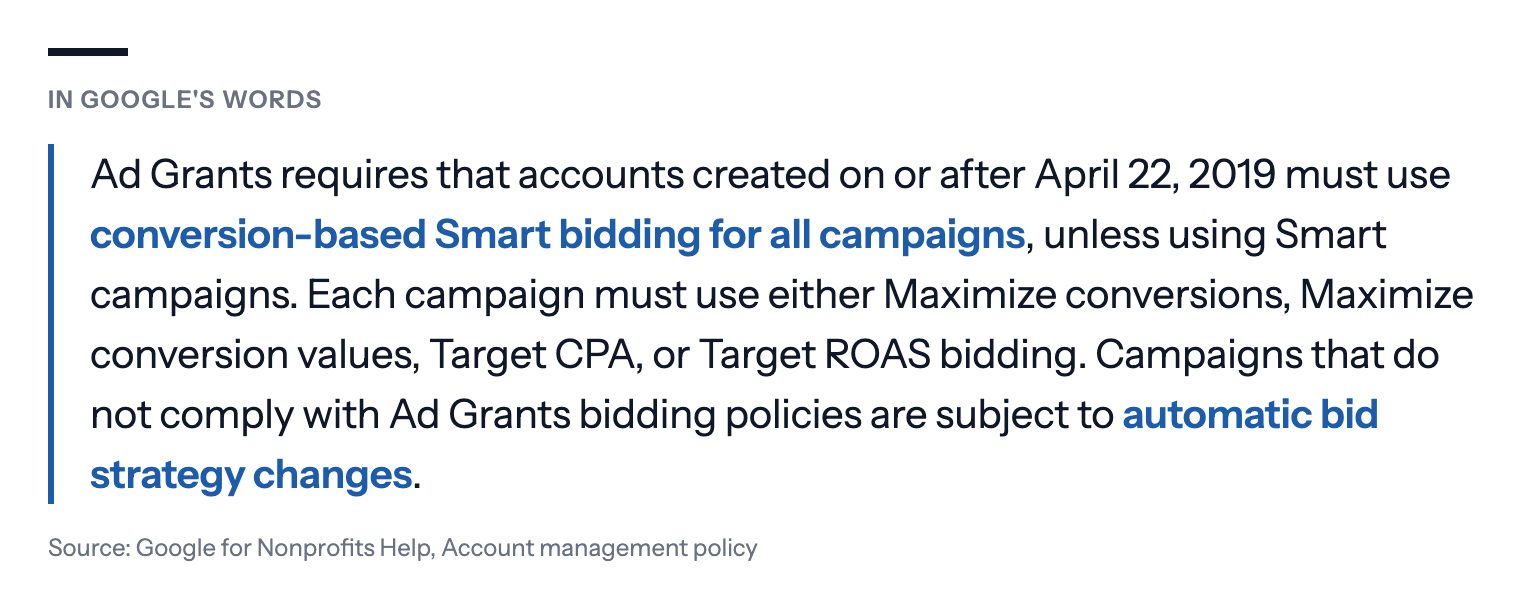
Conversion-based bidding. This is the rule most likely to surprise a nonprofit that set up its account with manual bids or Maximize clicks.
A 5% click-through rate. The account, not each keyword, has to keep a click-through rate (CTR) of at least 5% each month. Two months in a row below it, and the account can be temporarily deactivated until you fix it and ask for reinstatement.
No single-word keywords. Your own brand name, approved medical conditions and a few other cases are the exceptions.
No overly generic keywords. Google's examples are "free videos", "e-books" and "today's news": searches that don't say what the person wants.
No keywords with a Quality Score of 1 or 2. Quality Score is Google's 1–10 rating of how well a keyword, its ad and its landing page fit together.
Account structure. At least two ad groups in every campaign, at least two sitelinks in the account, and location targeting that matches where the people you help actually are.
Nonprofit Megaphone, the agency Grant Hensel founded, which manages Ad Grants accounts for nonprofits, puts the CTR rule bluntly in its compliance guide: "If your click-through rate is less than 5%, you're in danger of being suspended."
Why most of the grant goes unspent
There is no public Google figure for how much of the grant the average nonprofit uses. The numbers that circulate come from the agencies that sell Ad Grants management, which is worth keeping in mind.
The lowest one, quoted by several agencies without a named study, is about $300 a month: Getting Attention, which manages grant accounts, says "the average Ad Grant account only uses $300 out of the $10,000 monthly credits". Grant Hensel put it at $800, around 8% of the cap, in a 2025 podcast interview with Aleric Heck, who runs the YouTube ads firm AdOutreach.
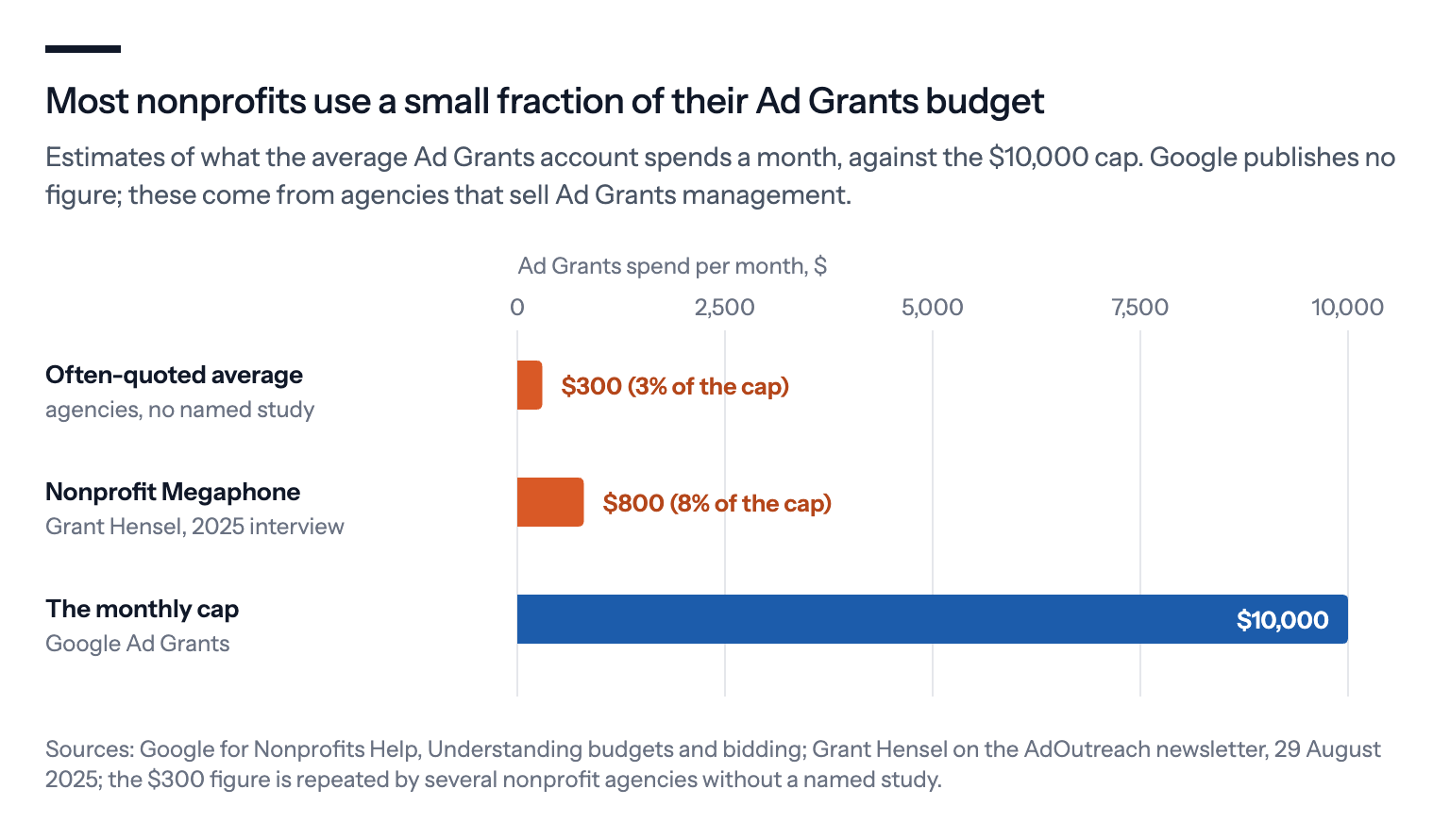
The reasons are mostly the rules themselves. Bidding for conversions needs conversions, so an account that tracks nothing meaningful has nothing for Google's bidding to aim at. Specific keywords keep the CTR up but reach fewer people. And many charities serve a city or a region, which shrinks the pool of searches further.
Rachel Clemens of Whole Whale, an agency that manages Ad Grants accounts for nonprofits, describes that last problem in her write-up of the 2025 changes: adding strict geographic limits on top of search shrinks the audience, which "makes it harder for local nonprofits to reasonably spend through their $10k per month Ad Grant allowance".
What changed recently
For most of its history, Ad Grants meant text ads on Google Search and nothing else.
Performance Max, the campaign type that picks where to show ads using Google's AI, reached Ad Grants accounts in early 2025, according to Whole Whale. In June 2025 Google announced that Ad Grants would also run on eligible Google Maps placements in Performance Max campaigns, "beside, above or below search results on Google Maps, including the Maps app". In the same post Google says Ad Grants has driven more than 14 billion visits to nonprofit websites in its 20-plus years.
Don't expect the full Performance Max of a paid account, though. Google's own help page says an Ad Grants campaign "may not be eligible to serve on all inventory", and Whole Whale wrote in July 2025 that Ad Grants Performance Max campaigns "can only place ads across eligible Search and Maps inventory".
For a food bank, a shelter or a museum with an address, Maps is the most useful part: people searching for help nearby see the organization where they're already looking.
A worked example
Take a food bank in a mid-size city, with a fictional account, set up a year ago and never touched since.
Last month it showed its ads 80,000 times and got 3,600 clicks, a CTR of 4.5%, below the 5% line. One broad keyword, "volunteer opportunities", accounts for 30,000 of those impressions and only 600 clicks, a CTR of 2%. Everything else together has 50,000 impressions and 3,000 clicks, or 6%.
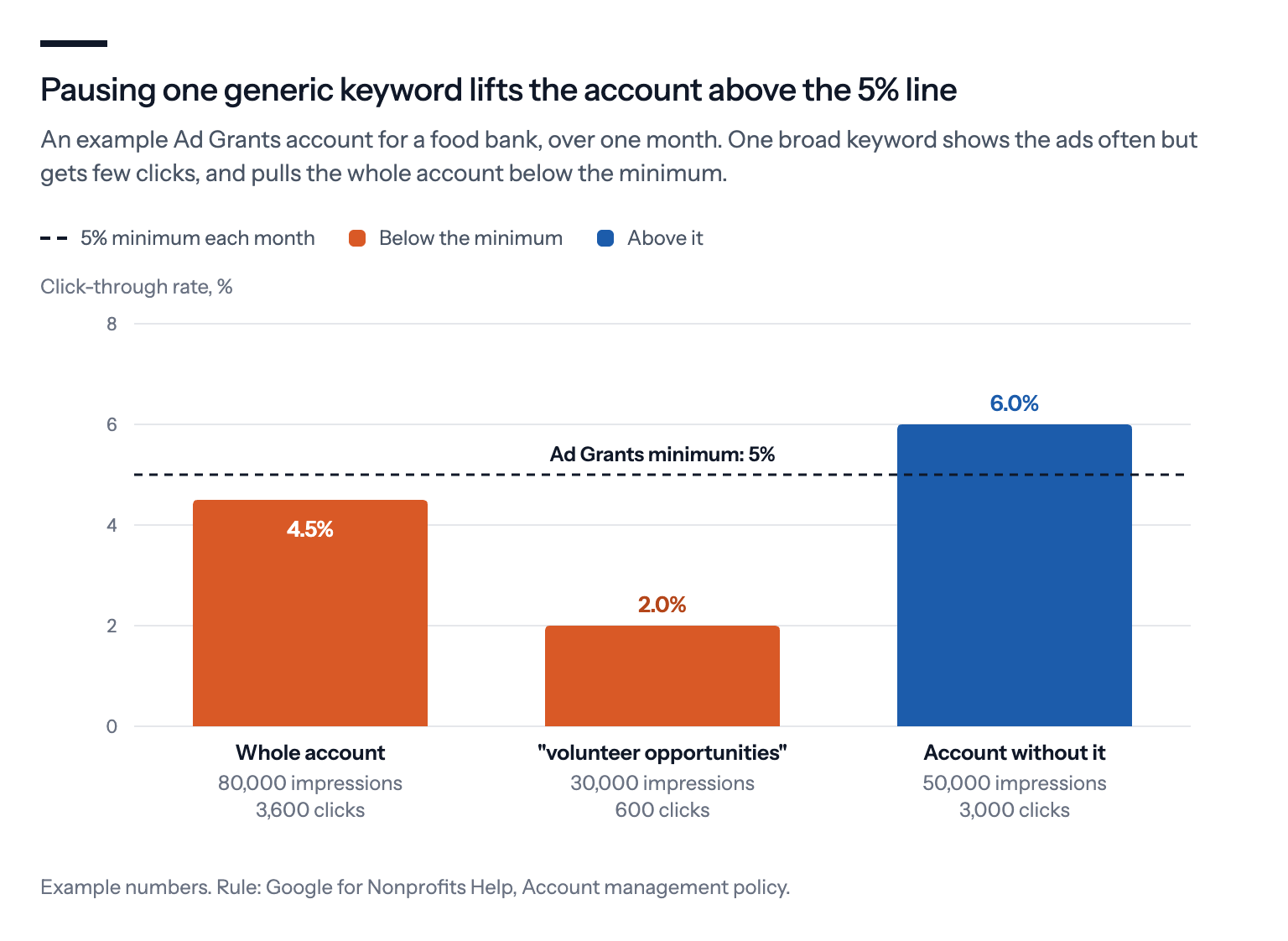
Pause that one keyword, or narrow it to "food bank volunteer [city]", and next month's account CTR is about 6% instead of 4.5%. It loses 600 clicks, about a sixth of its traffic, but it keeps the grant.
At an average cost per click of $1.80, the 3,000 clicks that remain use about $5,400 of the grant: more than half of it, and several times what the agencies' averages suggest. The way to spend more from there isn't broader keywords but more specific ones: one ad group per service and place, each with its own landing page and its own conversion.
Where the rules fall short
The rules make sense as a guard against waste, but they have rough edges, and it helps to know them.
Google contradicts itself on bidding. The policy says every campaign in a newer account must bid for conversions. Yet the same page's advice on getting reinstated, and the budgets page, say you "can begin with Maximize clicks to gather initial traffic and data", then switch once you have 15 to 30 conversions in 30 days. Read that as a short start, not a permission to stay.
A CTR floor favours narrow accounts. The easiest way to keep CTR high is to show ads on fewer searches. An account can comply perfectly and still reach very few people.
Performance Max is a grey zone. The CTR rule applies to accounts "not exclusively using Smart Campaigns", and Google doesn't say how Performance Max impressions count towards the 5%. Until Google says otherwise, plan as if they do.
The spend figures are thin. The $300 and $800 averages come from agencies that sell Ad Grants management, not from Google, and none of them publishes its method.
What we'd do
Track one conversion that matters before anything else. A donation, a sign-up or a call. Without it, the bidding rule can't be met and Google's bidding has nothing to aim at. Our guide to primary and secondary conversions explains how to choose it.
Switch every campaign to Maximize conversions. Use Maximize conversion value if you track donation amounts. Start without a target, and add one only when you have a month of data.
Check CTR every week, not every month. Sort keywords by impressions and pause or narrow the ones that show a lot and get few clicks, before they pull the month below 5%.
Build around services and places. One ad group per thing you do and where you do it, with keywords of two or more words and a landing page that answers the search. Our guide to match types explains how phrase and exact match keep searches on topic.
Try a Performance Max campaign if you have an address. The Maps placements are the one part of the grant that reaches people nearby while they look for help.
Set an automated rule for Quality Score. Google's compliance guide suggests one that pauses keywords at 1 or 2, so a bad keyword never sits in the account for long.
If you use Bavian, it manages a Grants account like any other Google Ads account, but it has no special Grants setting. Tell it in Memory that the account is a Grants account and which rules it must keep: our Help article has two texts you can copy. Bavian then keeps them in mind when it adds keywords and chooses bidding, and with Autopilot on, its daily tracking check shows tracking problems on the Agent page.