

Sometimes Google Ads really isn't for you. Far more often, it never got a fair run: running an account well takes weekly work, Google keeps changing the rules, and few small businesses have the hours or the in-house skills to keep up. Here's how to tell the two apart, and what it takes to give Google Ads a real chance.
"We tried Google Ads. It doesn't work for us."
We hear it often, from shops, dentists, software companies and craftsmen. And when we look at the account behind the sentence, the story is usually the same. Not a business that gave Google Ads a fair run and lost. A business that set it up, got busy with everything else, and watched the money go out without much coming back.
That's not a verdict on Google Ads. It's a verdict on how much work Google Ads takes, and how few businesses have the hours for it.
Sometimes, to be fair, the channel really is wrong. So let's take that first, and then talk about what usually happens instead.
The short version
- Sometimes it's true. If almost nobody searches for what you sell, or a sale is worth less than it costs to win one, no amount of work fixes it.
- Usually, it never got a fair run. Running an account well is weekly work: searches, ads, budgets, bids, tracking. It doesn't stop once it's set up.
- Google keeps moving the goalposts. We counted 280 changes to Google Ads in a year, and click prices keep rising.
- Someone has to say no. Google's suggestions mostly point one way: more reach, looser targets, bigger budgets. Some are good. The rest need someone to turn them down.
- Few small businesses can staff it. It takes hours every week, and someone who knows what they're looking at.
- So the account drifts, and "it doesn't work" becomes the conclusion before Google Ads was ever really tested.
When Google Ads really doesn't work
There are honest no's, and they're worth knowing.
Nobody searches for it. Search ads answer searches. A genuinely new product, or something people don't know they need yet, has little to answer. Google's own Keyword Planner gives a rough idea of how many people search for what you sell. Shopping, YouTube and remarketing can still reach people, but a plan built on Search won't carry the business.
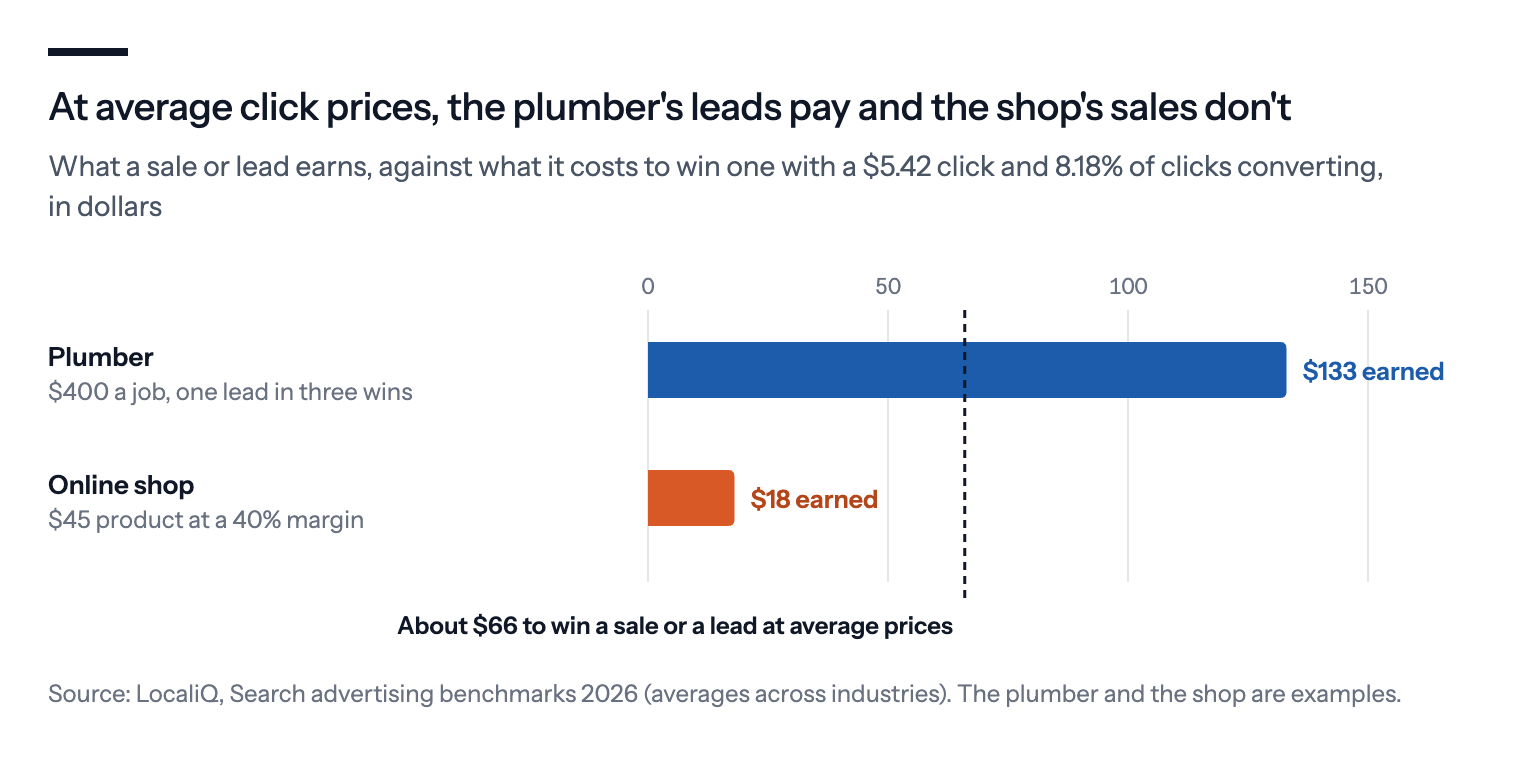
The numbers don't add up. Across industries, the average search click costs $5.42 and 8.18% of clicks convert, according to LocaliQ's 2026 benchmarks. At those averages, a sale or a lead costs about $66 to win.
An example, using those averages: a plumber who earns $400 on a job and wins one lead in three gets about $133 from each lead. At $66 a lead, the ads pay. A shop selling a $45 product at a 40% margin earns $18 a sale. At $66 a sale, every sale loses $48, and no account manager can fix that on Search. The fix is a bigger basket, a better margin or customers who come back. We show how to find your own break-even point in What is a good Google Ads ROAS for my business?
You can't take more customers. If you're booked for months, more leads cost money and bring nothing.
If one of these is you, "it doesn't work" is the right conclusion, and reaching it is worth something: it frees the money for what does.
But in our experience, they're the minority. Most businesses that say it don't fail on demand or arithmetic. They fail on the work.
Running a Google Ads account is a job, not a setup
Here's what nobody says loudly when you open a Google Ads account: launching the campaigns is the easy part. What makes them pay is everything after.
Every week, someone should be reading which searches the money actually went to, and blocking the ones that don't fit. Checking that sales and leads are still being counted, and counted once. Moving budget from campaigns that don't sell to ones that do. Replacing ads that don't work, and removing offers that ended. Adjusting what the bidding aims for as results come in.
None of it is hard on its own. Together, in our experience, it's a few hours a week for a small account, done properly, every week, by someone who knows what they're looking at.
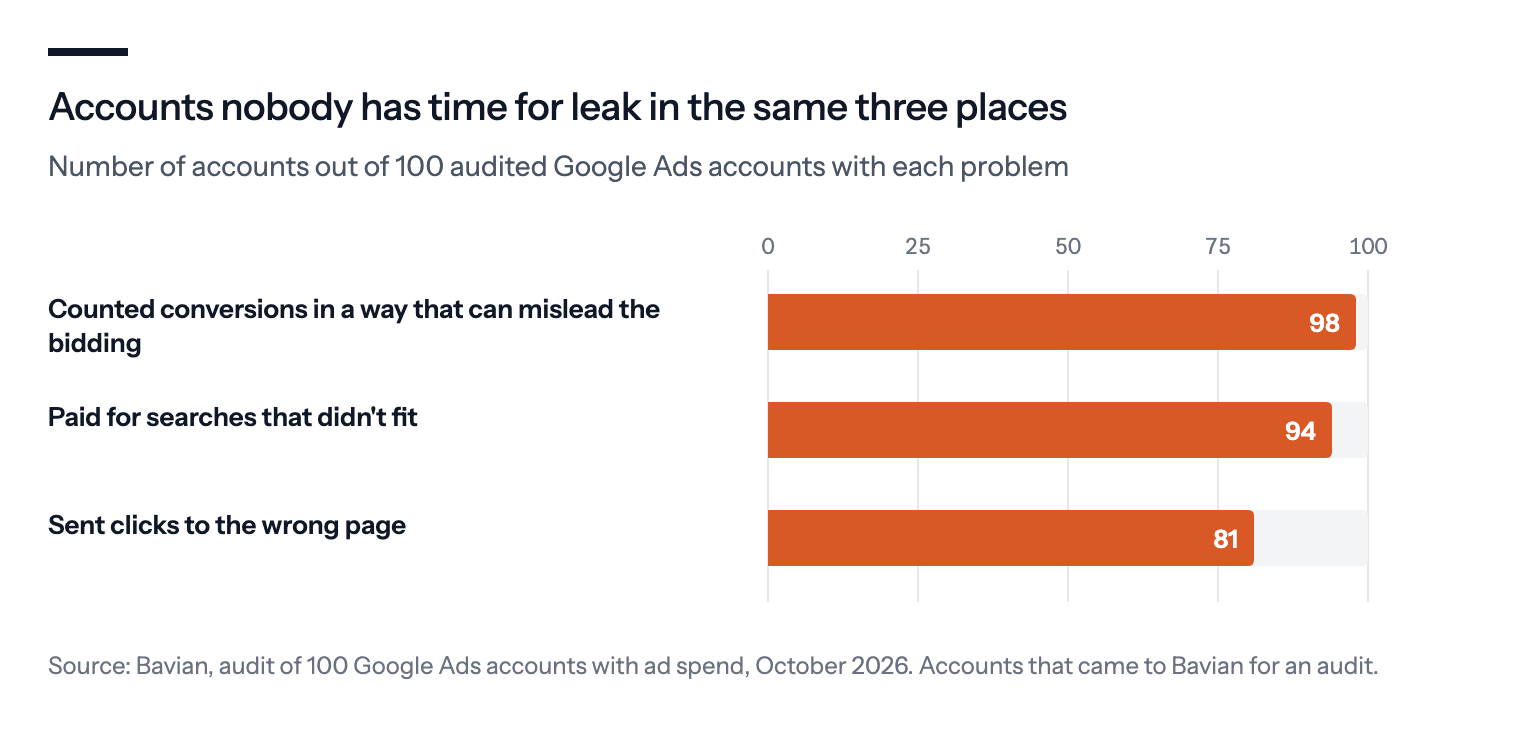
What happens when nobody does it shows up in the accounts. When Bavian audited 100 Google Ads accounts, 98 counted conversions in a way that can mislead Google's bidding, 94 paid for searches that didn't fit, and 81 sent clicks to the wrong page. These aren't businesses that made one big mistake. They're accounts nobody had time to look after.
"Many Google Ads accounts have a conversion tracking problem that is disguised as a strategy problem," writes the consultant Sarah Stemen in Search Engine Journal. I'd go one step further. It's often disguised as "Google Ads doesn't work".
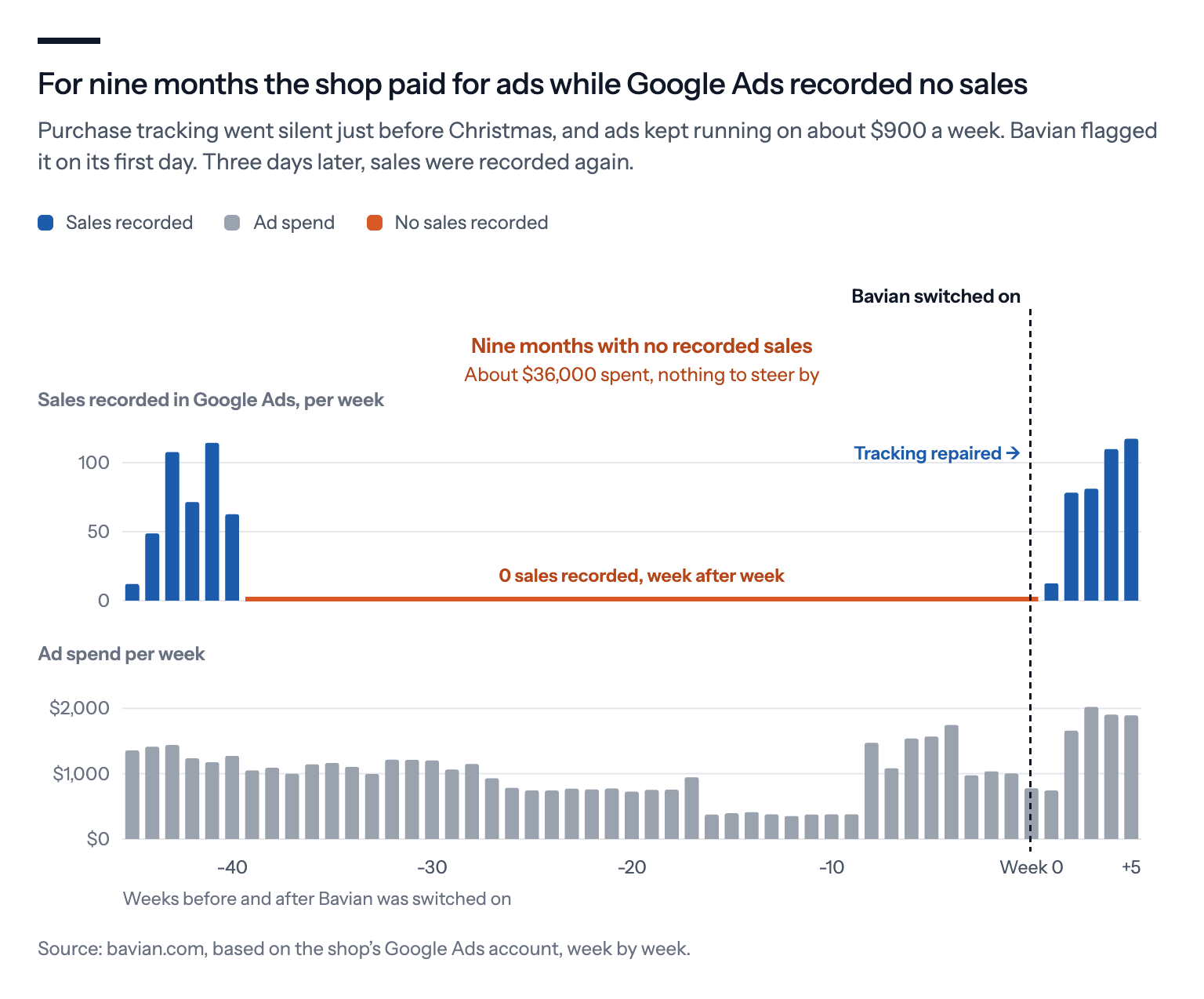
One account Bavian took over in September shows how this plays out. An online store selling e-bike parts had spent about $36,000 on Google Ads over nine months while Google Ads recorded no sales at all. The purchase tag had stopped working just before Christmas, and nobody noticed, because clicks and click prices looked normal. From the inside, it looked exactly like Google Ads not working.
Bavian flagged the silent tracking on its first day, and the owner had the tag repaired three days later. With sales visible again, the account told a different story: the campaign that had taken half the budget returned 0.2x, while one given a fifth of it returned 6.9x. In the first four weeks with tracking back, on a bigger budget moved to where it sells, the store recorded 39% more sales a week than before the tag broke, at a 2.8x return on ad spend. It isn't a controlled test, and four weeks is short, but the business that "didn't work" on Google Ads had been selling all along. The whole story is in Case: Nine months. $36,000 in Google Ads spend. Zero recorded sales.
Google Ads keeps changing, and so does the competition
Even an account that's well looked after doesn't stay that way on its own.
Google changes Google Ads constantly. We counted 280 changes in twelve months to Google Ads and Merchant Center, more than five a week, and many of the biggest were Google's own decisions. Since August alone, Google has changed how budget-limited Target CPA campaigns bid, switched on local inventory ads in every Standard Shopping campaign, moved some Search campaigns into AI Max and started adding automated promotions to ads. Each one can change what an account spends and where, without anyone touching it.
The competition moves too. Click prices rose a little over the past year, LocaliQ reports, and every competitor who gets better at Google Ads makes your clicks a little more expensive.
And Google keeps suggesting more. Its recommendations, its optimisation score and its budget emails mostly point the same way: show your ads in more places, loosen your targets, raise your budget. Of the 15 recommendation types Google lets software apply automatically, six widen where your ads show or loosen your target. Google calls its optimisation score "an estimate of how well your Google Ads account is set to perform", and the way to raise it is to act on Google's suggestions, not to sell more.
Some of those suggestions are good. But someone has to be the one who says no to the rest, and in an account nobody looks after, nobody does. Accepted defaults and applied recommendations pile up, and the account spends more without selling more. We've looked at why in "Limited by budget": should you raise your budget when Google suggests it?
So it isn't enough to set an account up well once. Someone has to keep up, and keep saying no, or last year's good setup quietly becomes this year's waste.
Who runs the account: four options
This is where most small and mid-sized businesses get stuck. There are three usual answers, each with a catch, and a newer fourth.
You do it yourself. It costs nothing but time, and it's a real option if you like it and have the hours. Most owners and marketing managers don't. Google Ads ends up as the thing they look at when there's time, which means after something has already gone wrong.
You hire a specialist. A good agency or freelancer does the work properly, and for many businesses that's the best answer there is. It's a real cost, though, and plenty of small accounts never get to the point of finding the right partner.
You let Google run it. Google's automation is good at bidding, and its new assistant, Ask Advisor, will help when you ask. But Google's defaults tend to widen where your ads show, and someone still has to decide which ones serve your business. We've written about that in Google's AI vs. an independent AI ad manager.
You let an AI ad manager run it. This is the newest option, and the one we build at Bavian. An AI that works in your own account every day, inside a budget you set, does the weekly work without waiting to be asked and shows what it changed and why. The catch is trust: you hand over the daily decisions, so it has to show its work and let you overrule it.
An example, as an illustration: a business spends $50 a day, about $1,500 a month. Looking after the account properly takes a few hours a week that the owner doesn't have, and nobody else in the business knows Google Ads. So the account gets set up, and then left alone. Google's suggestions get accepted because nobody has time to judge them. Six months later, it "doesn't work".
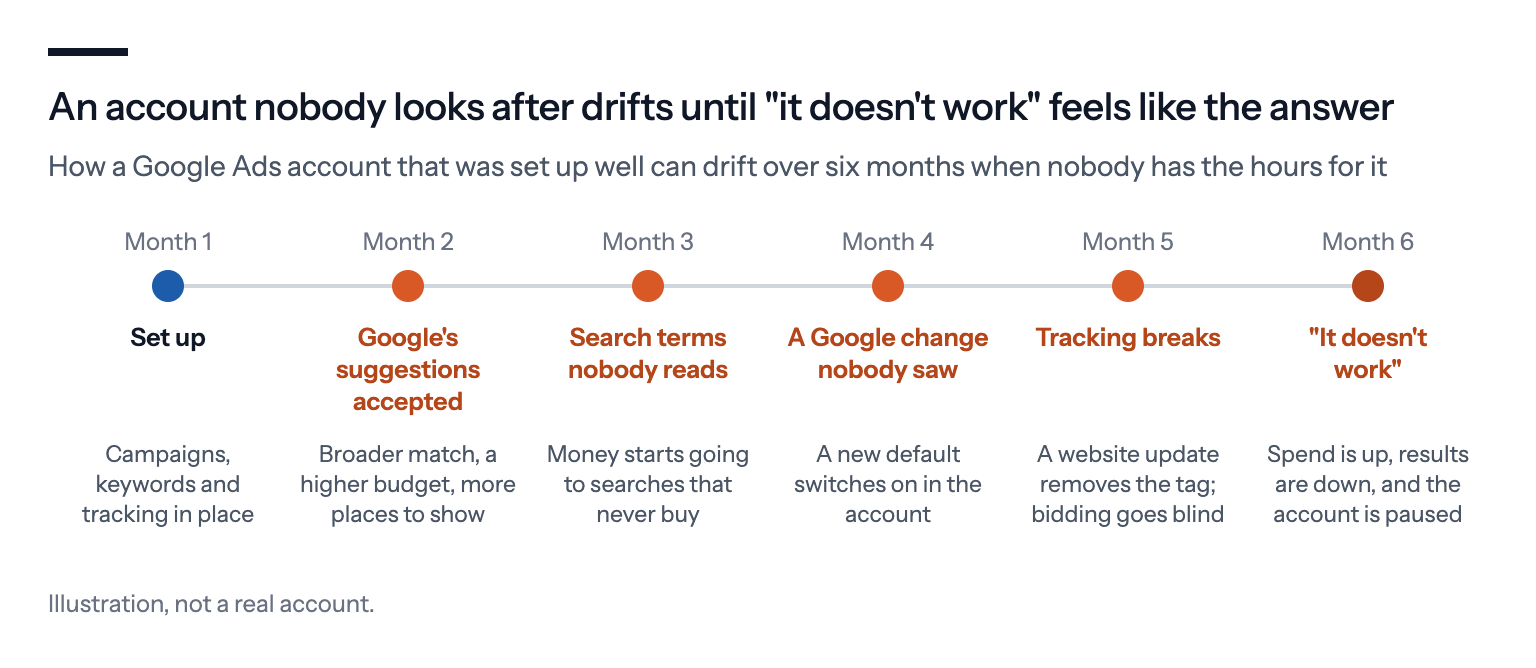
That's the gap most businesses fall into. Not too small for Google Ads. Just too busy to give it the work it needs.
When better account management isn't the answer
Sometimes the problem isn't the account. A slow website, a weak offer or prices well above competitors' can make good ads look bad. No account management fixes a page that doesn't sell.
Our audit numbers come from accounts that came to us. People who connect an account to an audit tool may have more problems than the average advertiser. The numbers say how common a problem is, not how much it cost.
Some businesses run it well themselves. If you have the time and the skills, you don't need anyone. That's a fine answer.
A fair run still costs money. Giving Google Ads a real chance means a budget big enough to learn from, for long enough to judge. We explain why in $20 a day on Google Ads? Not every business can afford the test.
How to give Google Ads a fair chance
Settle the honest no first. Is there search demand for what you sell, and is a sale worth more than about what it costs to win one? If not, stop here, with a clear conscience.
Decide who does the weekly work, before you decide the budget. An account nobody looks after will drift, however well it was set up.
Count the right thing before you judge. One real conversion per sale or lead, counted once. Otherwise you can't tell whether it works, in either direction.
Give it a fair run. Enough budget to learn from, three months, and a stop rule you set up front. Then "it doesn't work" is a finding, not a feeling.
Why we built Bavian
This is the gap we built Bavian for. At Bavian, we go to work every day so businesses that don't have the hours can let Autopilot run their Google Ads from A to Z, safely. It does the weekly work every day, in your own account: saying no to Google's automatically applied recommendations, blocking searches that waste money, checking that conversions are counted, moving budget toward what sells, keeping up with Google's changes and showing every change, with the reason, on the Agent page. The free analysis shows what's holding your account back before anything changes, and if Google Ads really isn't for you, we'd rather you found that out than kept paying for it.