
Below $20 a day, three in four accounts we audited got fewer than 15 conversions a month, which slows down what Google's bidding can learn. Here are the five mistakes that cost small budgets most, what Bavian does about each, and why we'd work towards $100 a day.
"Google Ads doesn't work for us." We hear it most from businesses spending $10 or $20 a day. Sometimes they're right: not every product can win at today's click prices. But often the first mistake isn't in the account at all. It's the budget.
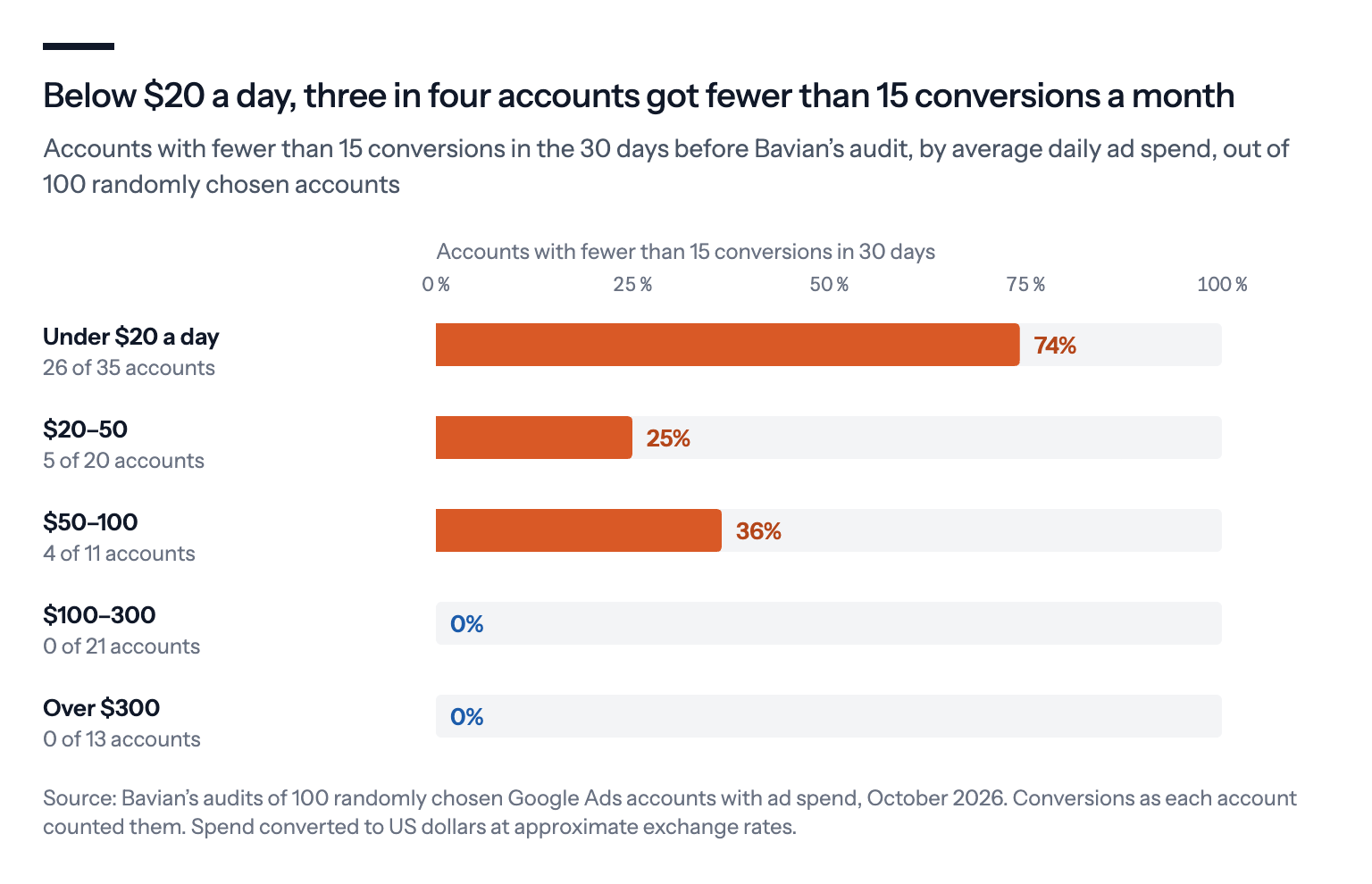
We picked 100 accounts with ad spend at random from those Bavian had audited by October 2026. 35 of them spent less than $20 a day on average, and 66 spent less than $100 a day.
Here's what goes wrong on a small budget, what Bavian does about it, and our honest view on how much you need.
The short version
- Of the 35 accounts spending under $20 a day, 26 got fewer than 15 conversions a month. Of the 34 spending $100 or more, none did.
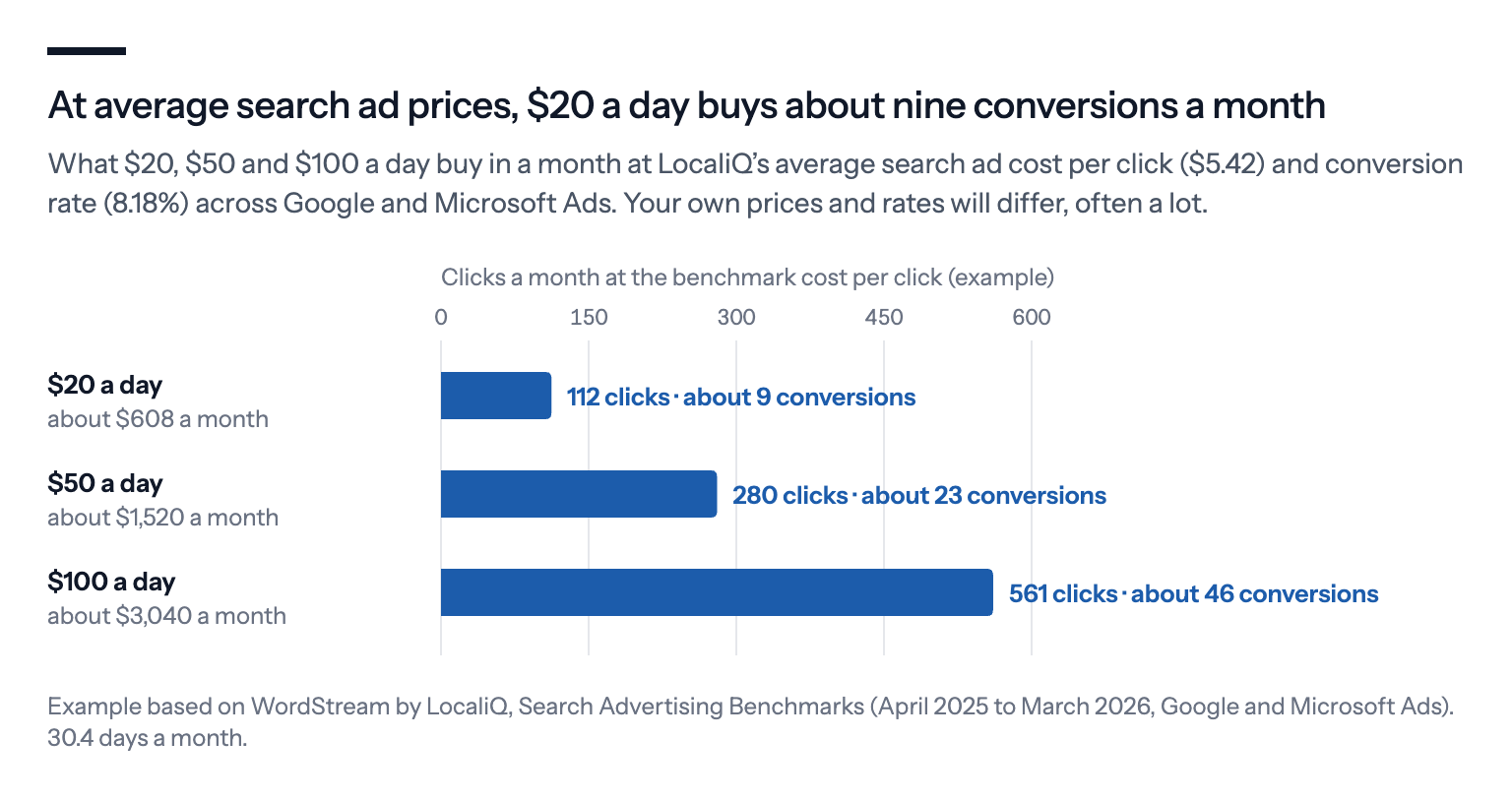
- At average click prices, $20 a day buys about four clicks a day. That's too little for Google's bidding to learn much from, and too little to judge quickly.
- Small budgets also get split too thin, reach too far and get changed too often.
- Our rule of thumb is to work towards $100 a day, with real exceptions for cheap clicks, deliberate tests and margins that can't carry it.
1. The budget is too small to learn from
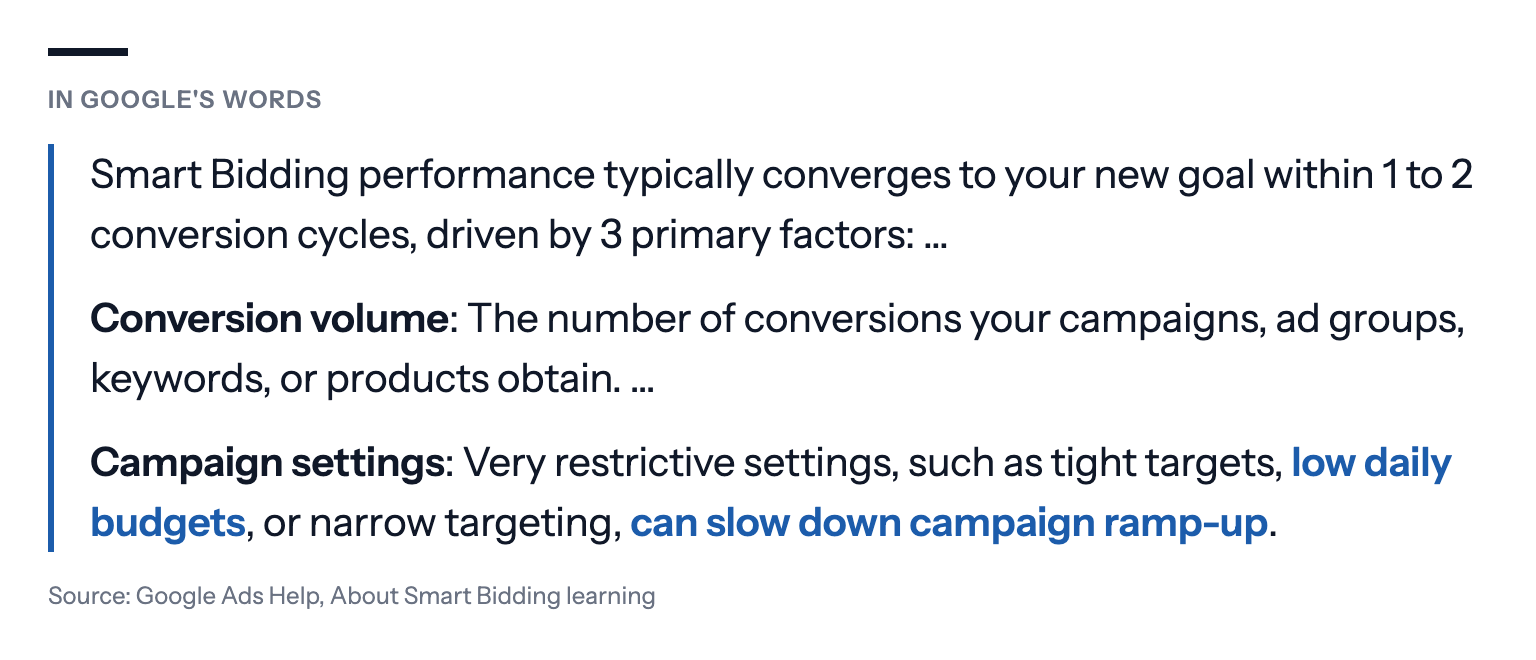
Google's bidding learns from conversions: which searches, times and people lead to a sale or a lead. Fewer conversions mean slower and noisier learning. Google says so itself, and names low daily budgets as one of the settings that can slow down a campaign's ramp-up:
In the accounts we looked at, the difference was stark. Of the 35 accounts spending under $20 a day, 26 recorded fewer than 15 conversions in the 30 days before the audit. That's one every other day at most, and those are conversions as each account counted them, often including soft ones. Of the 34 accounts spending $100 a day or more, none did.
The arithmetic explains why. The average search ad click costs $5.42 across industries, and 8.18% of clicks convert, according to LocaliQ's 2026 benchmarks from its customers' Google and Microsoft Ads campaigns. At those averages, $20 a day buys about four clicks a day and about nine conversions a month:
In expensive trades it's worse. A click for home improvement costs $8.33 on average, and for legal services $9.87, so $20 a day buys two clicks.
Google's own budget advice points the same way. For Performance Max, it recommends a daily budget of at least three times your cost per conversion. At LocaliQ's average cost per lead of $66.69, that's about $200 a day.
Our rule of thumb: work towards $100 a day
Our view is that most businesses should aim to spend at least $100 a day on Google Ads, or the same in their own currency. It isn't a law. It's roughly where an average account starts getting enough clicks and conversions for Google's bidding, and for Bavian, to learn what works and act on it.
Some nuance:
- Cheap clicks need less. In a niche where clicks cost a dollar or two, $40 a day can bring as many clicks as $100 does in a busy market.
- Expensive clicks need more. If a click costs $10, $100 a day is ten clicks.
- Start smaller, but on purpose. A small budget is fine for a test with a stop rule. We explain how in How to test non-brand search on a small budget without wasting money. It's spending $20 a day for a year and expecting it to grow that rarely works.
- If the margin can't carry it, say so. If a sale is worth $30 to you and clicks cost $5, Google Ads may not be your channel at any budget. Knowing that is worth something too.
What Bavian does: Bavian never raises your total daily budget on its own. When more budget would pay off, it can suggest a higher total on the Agent page, and only the owner can approve it. With very few conversions, as on many small budgets, it also changes less based on results until it has enough to go on.
To be straight about the cost: Bavian's Autopilot costs $150 a month whatever you spend, plus VAT where it applies. At $20 a day, that's about a quarter of your ad spend. At $100 a day, it's about 5%. See Is Bavian worth it for small Google Ads accounts with low budgets?
2. The budget is split across too many campaigns
A small budget spread thin is smaller still. The 35 accounts spending under $20 a day ran more than two campaigns on average, at under $5 a day each. Nine of them ran three or more. At under $5 a day and average click prices, a campaign gets less than one click a day.
For example, a bike repair shop with $15 a day splits it across a Search campaign, a brand campaign and Performance Max, at $5 each. None of them gets enough clicks to learn anything.
Jyll Saskin Gales, a Google Ads coach who spent six years at Google, puts the principle simply: don't try to do too much with too little. Fewer keywords, locations and ad groups, and in our view fewer campaigns, let a small budget reach the searches that matter often enough to learn something.
What Bavian does: Bavian treats your total daily budget as one pot and decides how to split it across your campaigns, moving money towards the ones that sell. It can give one campaign most of the budget and let the rest run small, or switch them off, so the money isn't spread thinner than it can work.
Pro tip: If one campaign matters most to you, say so in the chat on the Agent page, or set its budget yourself on the Budget page. Bavian plans the other campaigns around it.
3. Settings that reach too far
On a big budget, a little waste disappears in the average. On a small one, a handful of wrong clicks is the whole day. The settings that cost small accounts most:
- Location. Google's default reaches people interested in your area, not just people in it. For a local business, clicks from elsewhere can eat a large share of a small budget.
- Broad match without data to steer it. Broad match can be useful once a campaign converts well. On a new, small campaign, it often buys searches you didn't mean. See Broad, phrase or exact match in 2026.
- Searches that don't fit. Competitors' names, free and DIY searches, jobs.
Picture a yoga studio spending $15 a day that pays $3.80 for a click on "free yoga videos for beginners". That's a quarter of the day's budget on someone who wanted to stay home.
What Bavian does: Every day, Bavian reads your last 30 days of searches and blocks those that clearly don't fit your business, and those that cost money without results once there's enough to go on. It reads which country the people who clicked were in, and can switch a campaign to reach only people in your area when spend from elsewhere doesn't pay.
4. Bidding for conversions with too few conversions
Smart Bidding strategies, such as Maximize conversions or a target CPA, need conversions to steer by. In the accounts we looked at, we saw a campaign on Maximize conversions with no target and not a single conversion from more than 80 clicks, and another with one conversion in three months.
The opposite mistake exists too: Maximize clicks with no limit on what a click may cost. In one account, a single click cost about $12 on a budget of under $8 a day.
What Bavian does: Bavian only moves a campaign to bidding for conversions when your tracking can be trusted and the campaign has enough conversions. If your account records no conversions at all, it sets no targets, and steers on clicks, cost and which searches fit your business instead.
5. Judging too early, and changing too often
On a small budget, results swing. Three sales one week and none the next can be pure chance. The common reaction is to change something: a new bid, a new target, a new budget.
Some changes put a campaign into Google's "Learning" status. Its guide to the learning period lists a new or switched bid strategy, campaigns, ad groups or keywords added to or removed from the bid strategy, and significant changes to the conversion goals you optimise for. Others, such as a new target or budget, don't trigger a learning status, but they still change what the campaign is doing, so the next week can't be compared with the last. Change one thing at a time, and give it time.
What Bavian does: Bavian judges campaigns over weeks, not days. For some bigger changes, it names the number the change should move and checks it after a set period, before it changes the same thing again. It avoids moving the same setting again before its last change has had time to show, and caps how far a bid target can move in seven days. The Agent page says what it changed and why, so you can see the plan instead of guessing at it.
Pro tip: Give a change at least two to four weeks before you judge it. With fewer than 15 conversions a month, a week is too short to tell good from bad.
Where the $100 rule falls short
A rule of thumb is a starting point, and this one has honest limits.
The data shows a pattern, not a cause. Small accounts in our sample got fewer conversions, but some of them are small because their market is small, or because Google Ads didn't work for them. More budget wouldn't fix that.
Averages hide whole industries. At $1.63 a click, LocaliQ's average for arts and entertainment, $40 a day buys more clicks than $100 does at a lawyer's $9.87. Work out your own number from your own click price and conversion rate.
A bigger budget can lose money faster. If the tracking counts the wrong thing, or the landing page doesn't sell, more budget buys more of the problem. Fix the account first, then grow it.
Some businesses don't need Search at all. A shop with a handful of loyal local customers and no search demand may get more from its free Google Business Profile than from any ad budget.
What we'd do on a small budget
Put the money in one place. One campaign that sells beats three that each get a click a day.
Narrow the reach. Your area, your best products or services, and the searches that buy.
Count the right thing. One real conversion, counted correctly, before you hand the bidding to Google.
Change one thing at a time. And give each change two to four weeks.
Plan to grow. Work towards $100 a day, or decide that Google Ads isn't the channel. Staying at $20 a day forever is the one choice that rarely pays.
If you'd like to see what Bavian would change in your account, the audit is free, and nothing changes until you turn on Autopilot. Autopilot needs a total daily budget of at least $7, or the same in your currency.
We found the same patterns across every kind of account. See Bavian audited 100 Google Ads accounts. The same 5 mistakes kept showing up.
About the numbers: we drew 100 accounts with ad spend at random from those Bavian had audited by October 2026. Average daily spend and conversions are from the 30 days before each audit. Spend is converted to US dollars at approximate exchange rates, and conversions are as each account counted them. The examples are illustrations, with details changed so no account can be recognised.