

Since 27 September 2026, EU law bans generic green claims such as "eco-friendly" unless you can prove excellent environmental performance, and bans "climate neutral" claims based on offsetting. In Google Ads, the catch is that a claim and its explanation must appear in the same ad, and responsive search ads don't promise to show them together.
Search your own Google Ads account for "eco", "green", "sustainable" or "climate". If you sell to consumers in the EU, chances are a headline or two turns up, written years ago and never looked at since.
Since 27 September 2026, many of those headlines break the law. The EU's directive on empowering consumers for the green transition, often called the ECGT or EmpCo, applies from that date, and it was written with exactly that kind of short, vague claim in mind.
Search ads are short, and responsive search ads are assembled by Google from pieces you supply. That makes them an awkward fit for the new rules. Here is what changed, why ads are a special case, and what to check.
The short version
- Generic claims such as "eco-friendly", "green" or "climate friendly" are banned unless you can show recognised excellent environmental performance, for example the EU Ecolabel.
- A claim isn't generic if it's specified "in clear and prominent terms on the same medium", such as the same ad. "Bottles made from 80% recycled steel" is specific; "eco bottles" is not.
- Claims that a product is "climate neutral" or has a reduced climate impact because of carbon offsetting are banned outright.
- Unless you pin assets, responsive search ads can show any headline with any description, so a claim and its explanation may not appear together. Google says your assets must make sense "individually or in combinations" and not break local law.
- There is no grace period for online ads: the rules apply to ads already running.
What the directive bans
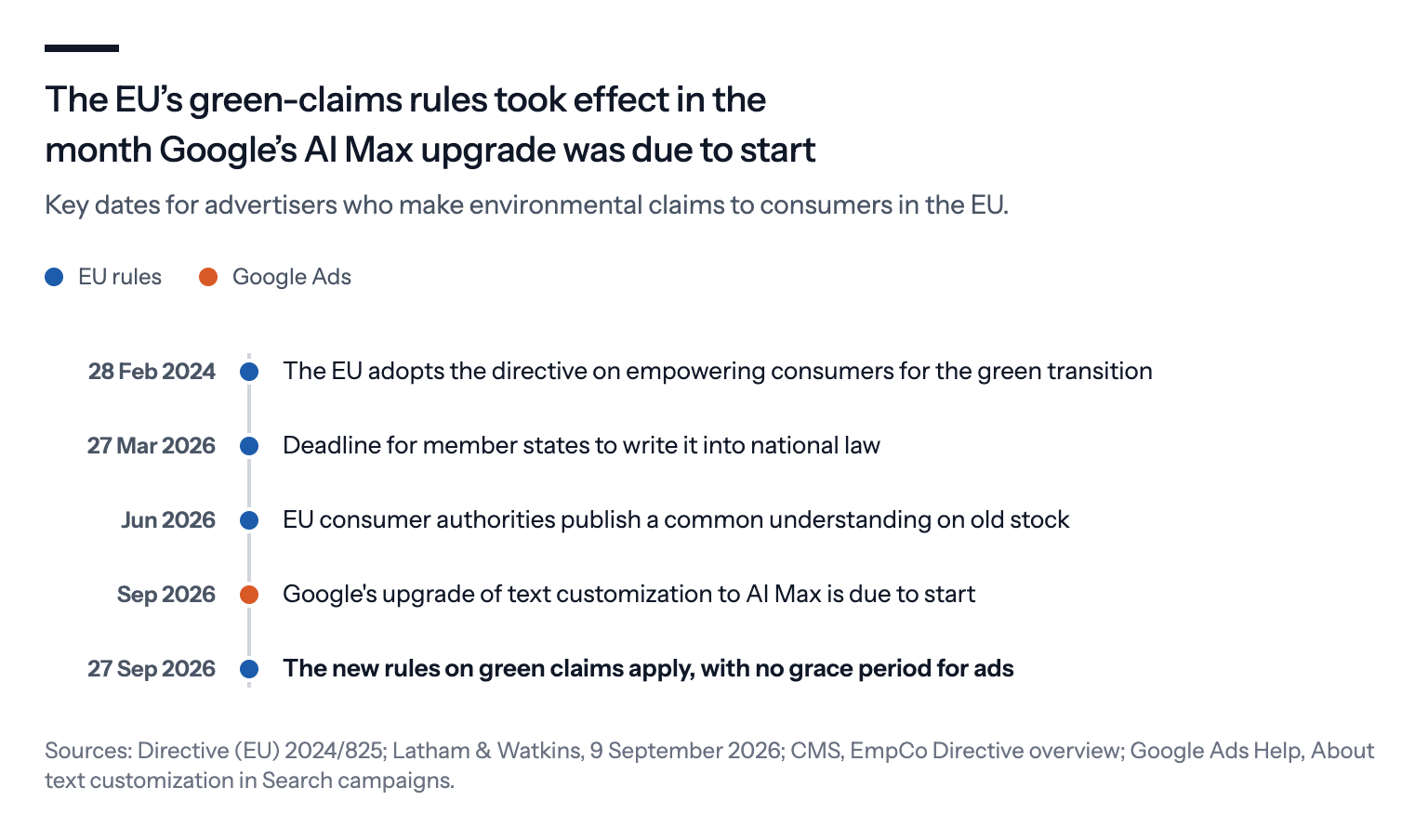
The directive amends the EU's rules on unfair commercial practices. Member states had to adopt it by 27 March 2026 and apply it from 27 September 2026.
It adds new practices to the list that is banned "in all circumstances", which means a regulator doesn't have to show that a consumer was actually misled. Four of them matter for ads.
Generic environmental claims without "recognised excellent environmental performance relevant to the claim". The directive's own examples include "environmentally friendly", "eco-friendly", "green", "climate friendly", "energy efficient" and "biodegradable". Excellent performance can be shown through the EU Ecolabel, an officially recognised national ecolabel, or top performance under other EU law.
Claims about the whole product or business when they only concern one part of it. Latham & Watkins, a law firm that advises companies on the rules, gives the example of a product promoted as "made with recycled material" where only the packaging is, in its guide from September.
Offset-based climate claims. Claiming that a product has a "neutral, reduced or positive impact" on greenhouse gas emissions because of offsetting is banned. The directive lists "climate neutral", "CO2 neutral certified", "carbon positive" and "climate compensated" as examples.
Sustainability labels that aren't based on a certification scheme or set up by public authorities. A home-made badge in an image asset counts.
The definition of an environmental claim is wide. Latham notes that it covers text, images and symbols, and even brand names, company names and product names. A product called "EcoKettle" in your Shopping feed is a claim too.
Why search ads are a special case
The directive draws its line between generic and specific claims with an example that could have been written about ads.
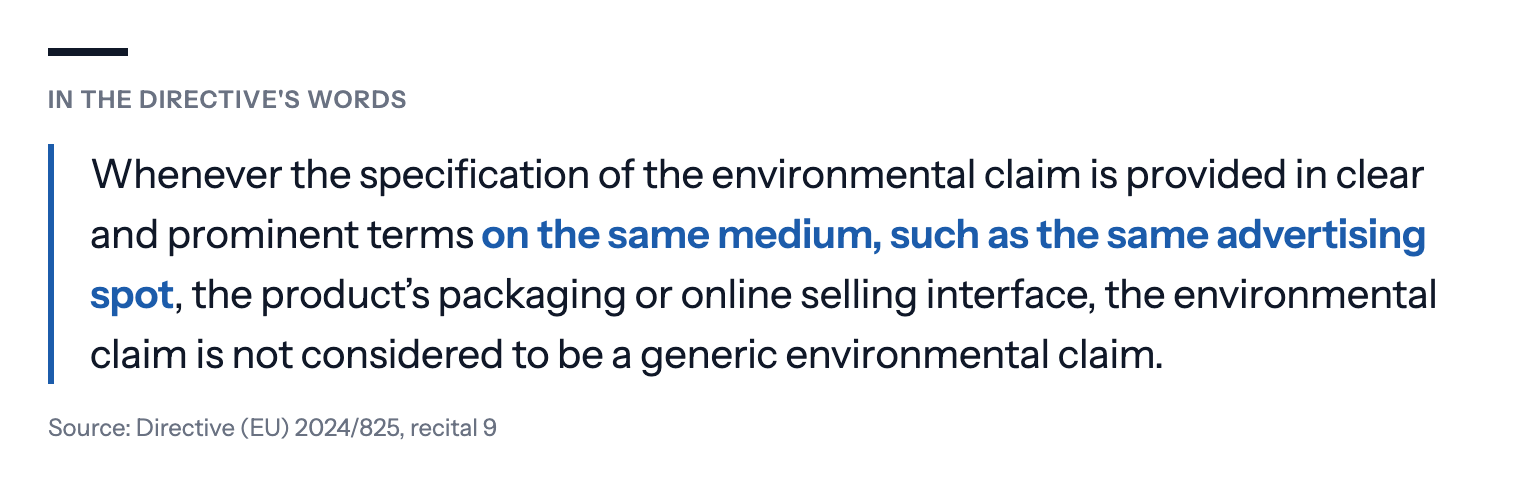
So "climate-friendly packaging" is generic, while "100% of energy used to produce this packaging comes from renewable sources" is specific. The explanation has to be in the same place as the claim. A landing page that explains it doesn't help the ad that makes it.
A headline in Google Ads has 30 characters, which leaves very little room for a specification, and according to CMS, the Commission's own Q&A says a lack of space doesn't excuse a missing one. And a responsive search ad, the standard text ad format, isn't one fixed text. You give Google up to 15 headlines and 4 descriptions, and it picks at least one of each to show, in combinations it tests. Google's own help page puts the consequence plainly.
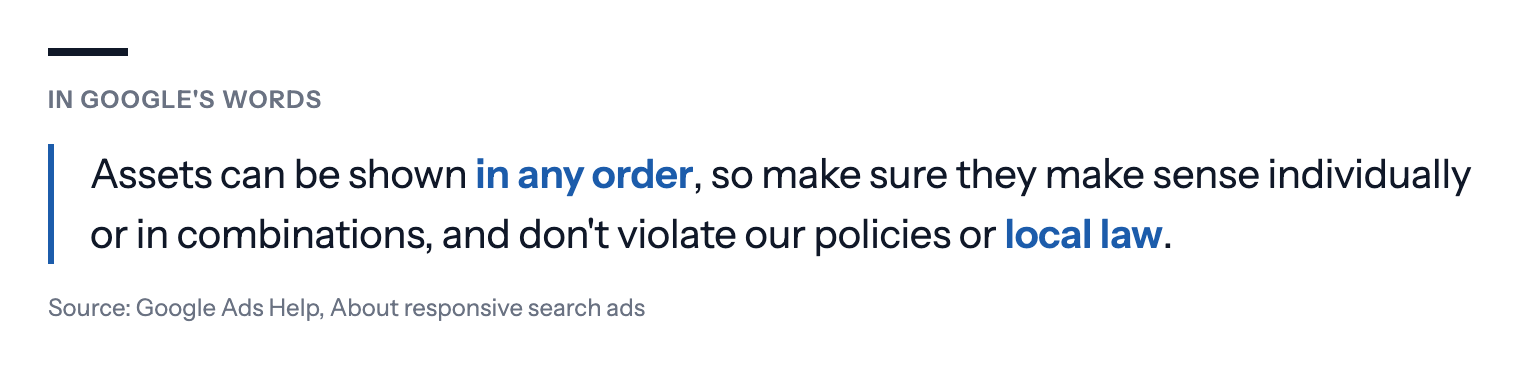
A headline that says "Eco-Friendly Water Bottles" and a description that explains the recycled steel may never appear together. Each headline has to hold up on its own.
The second change this autumn: text Google writes for you
In the same month the directive took effect, Google was due to start moving Search campaigns that use text customization, the setting formerly called automatically created assets, into AI Max. According to Google's help page, the upgrade starts in September 2026.
Text customization writes extra headlines and descriptions from your landing page, your domain and your existing ads, partly with generative AI. If your website calls a product "sustainable" or "planet-friendly", those words can end up in ads you never wrote.
Google's page says what it expects of you: "Ensure your website content is accurate, not misleading, and not in violation of Google Ads policies or applicable laws." The ad-level asset report shows which generated assets have run.
A worked example
Take a fictional online shop selling reusable steel water bottles to customers in Germany and the Netherlands. Its responsive search ad has these headlines among others:
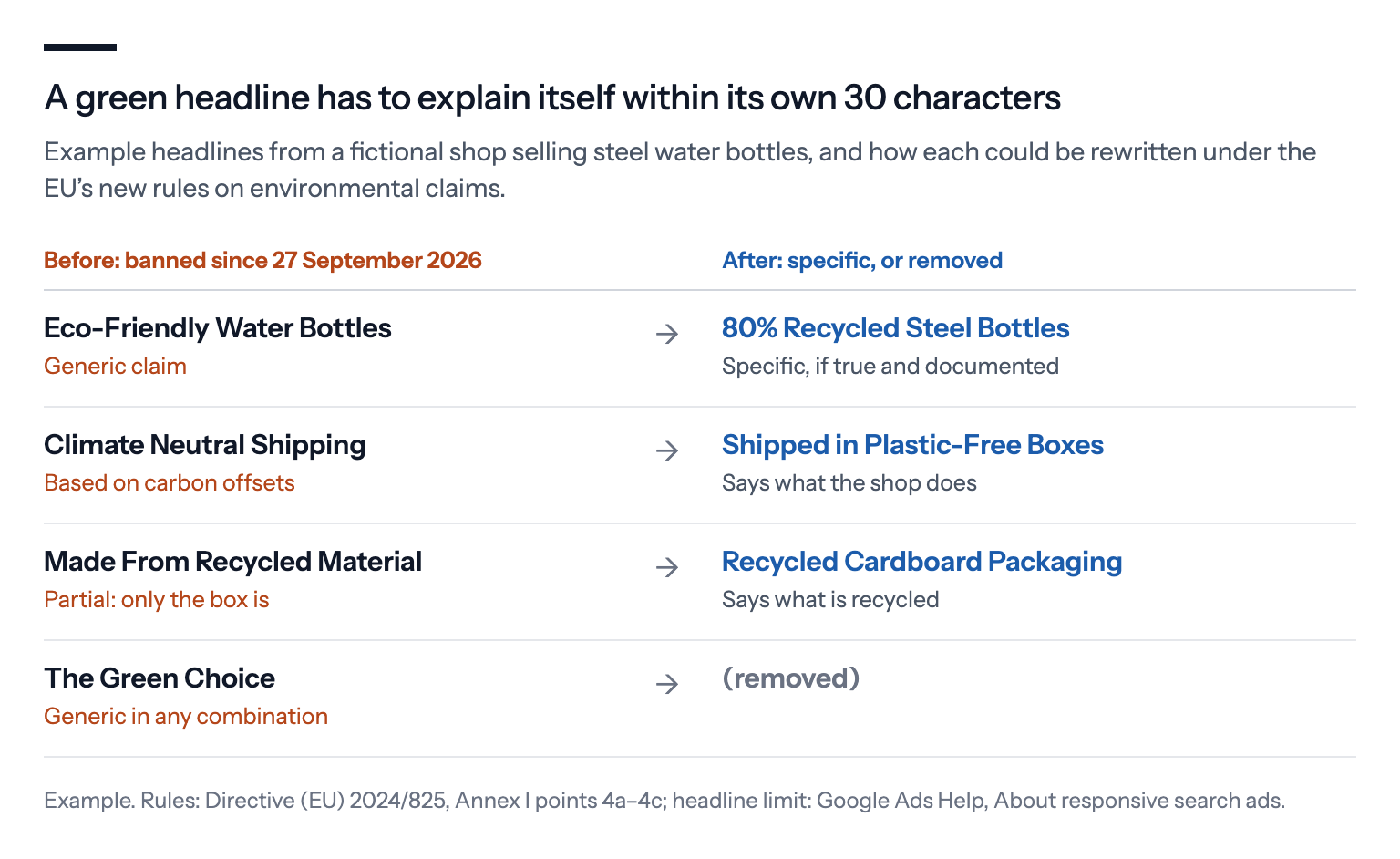
"Eco-Friendly Water Bottles" is a generic claim. Unless the bottles carry the EU Ecolabel or an equivalent, it has to go or become specific: "80% Recycled Steel Bottles" fits in 26 characters, provided it's true and documented.
"Climate Neutral Shipping" rests on the carbon credits the shop buys for its deliveries, which is exactly the offset-based claim the directive bans. What the shop can say is what it actually does, for example "Shipped in Plastic-Free Boxes".
"Made From Recycled Material" is a partial claim if only the box is recycled. "Recycled Cardboard Packaging" says what is.
And "The Green Choice" is generic however it's combined, so it simply goes.
The shop also checks its sitelinks, image assets and Shopping titles. A leaf icon with "100% green" in an image asset is a claim, and so is a product titled "Eco Bottle 750 ml".
Timing: no grace period for ads
The rules apply to ads already running. Latham writes that there is "no transitional relief" from 27 September 2026, "including for existing products".
For packaging printed before that date, the EU's network of consumer authorities published a non-binding "common understanding" in June 2026 that asks authorities to show restraint. But as CMS, a law firm that advises companies on the rules, sums it up in its overview for Germany, traders must still show they have taken steps to comply, "for example by ordering new packaging materials or amending online claims". An ad can be changed in minutes, so expect little patience with one that hasn't been.
Enforcement runs through each country's consumer authorities and courts, and competitors can sue too. In Germany, CMS reports, most cases are civil, the authorities' common understanding is "unlikely" to matter to the courts, and two groups that bring such cases, the Wettbewerbszentrale and Environmental Action Germany (DUH), have announced legal action.
Where it falls short
National law decides the details. The directive sets the list, but each member state transposes and enforces it. Transposition has been uneven: in May 2026 the Commission opened infringement procedures against 20 member states that had missed the March deadline, Latham notes. And courts will decide what counts as "excellent environmental performance" or a "clear and prominent" specification. Expect the first cases to shape the practice.
Google doesn't check this for you. Google's own help page leaves it to you to make sure your assets don't break local law. An approved ad isn't a compliant ad.
Not everything green is banned. Specific, true and documented claims stay allowed, and so do certified labels. The rules punish vagueness, not environmental effort, and some shops will overcorrect and drop claims they could have kept.
B2B is mostly outside. The directive covers communication to consumers. Ads aimed only at businesses fall largely outside it, though, as Latham notes, some countries, such as France, apply parts of the rules to B2B as well.
What we'd do
Search your account for the words. Eco, green, sustainable, climate, CO2, carbon, natural, biodegradable and recycled, across headlines, descriptions, sitelinks, image assets and product titles.
Make every headline stand on its own. If a claim needs an explanation, put the explanation in the same headline, or drop the claim. Don't rely on a description to complete it unless it's pinned to Description position 1, which Google says always shows.
Remove offset-based climate claims. "Climate neutral" or "CO2 compensated" because of carbon credits is banned whatever the quality of the credits.
Check what Google writes for you. If your campaigns use AI Max or text customization, look at the generated assets in the asset report, and clean up the green wording on your landing pages, since that's where Google takes it from.
Write down your rules. Agree which claims you can document, keep the evidence, and give the list to whoever writes your ads, human or not.
If you use Bavian, add your rules under Memory on the Context page, for example "Never call our products eco-friendly or climate neutral", and Bavian follows them when it writes ads. Bavian also never switches on AI Max, which can write ad text from your landing page, without your yes.