
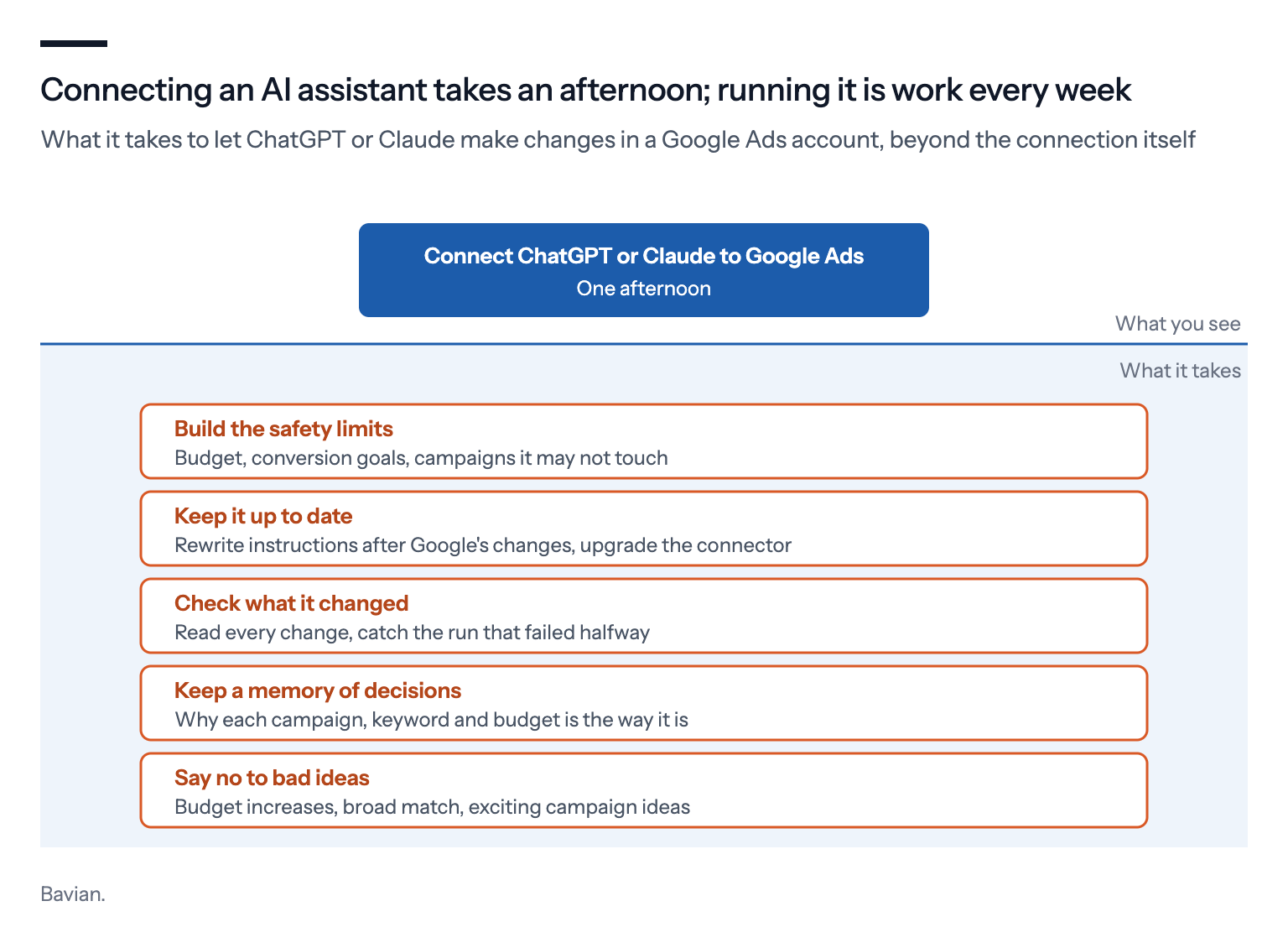
You can connect ChatGPT or Claude to your Google Ads account in an afternoon. Connecting is the easy part. Keeping it safe, current and watched every day is a job of its own, and for most businesses it's the very job they wanted to get rid of.
A year ago, asking ChatGPT about your Google Ads meant pasting in an export and getting a second opinion. Today you can skip the pasting. Connect Claude or ChatGPT to your account, and it reads your campaigns directly. With the right connector, it can change them too.
So the question has moved. It's no longer whether a general AI assistant can work in your Google Ads account. It can. The question is whether you want to be the one who runs it.
It's also a question we hear often at Bavian, where we build an AI that runs Google Ads accounts on Autopilot: "Why not just connect Claude?"
My answer: you can, but for most businesses I wouldn't let it run the account. Not because the assistants aren't clever. They are. But connecting them is the easy part, and everything after it is a job: setting the limits, keeping it current, watching what it does, and catching it when it's wrong. Most people who look at AI for Google Ads want to get rid of that job, not take on a new one. That's the difference between an assistant and an autopilot.
The short answer
- Yes, you can connect them. Google offers a read-only connector, others offer connectors that can make changes, and the Google Ads API is open to anyone who applies.
- Connecting is a day's work. Running it is every day's work. Limits, updates, monitoring and clean-up don't go away; they move from the account to the agent.
- A general assistant doesn't know your rules unless you tell it, and doesn't keep up with Google unless someone keeps it up.
- As an analyst, it's excellent. Read-only access and you making the changes is a setup worth having.
- Running an account safely is a product, not a prompt. That's the bet behind Bavian, and why we built it.
Yes, you can connect ChatGPT or Claude to Google Ads
There are three ways in.
Google's own connector. In October 2025, Google released an open-source MCP server for the Google Ads API. MCP is the standard ChatGPT and Claude use to talk to other software. Google's server is read-only: the assistant can query and report on the account, not change it. You host it yourself.
Third-party connectors. Several companies sell connectors that sit between an AI assistant and your Google Ads account, and some of them can make changes.
The API directly. Anyone technical enough can give an AI agent access to the Google Ads API and let it read and write. Access to real accounts needs an application to Google, and since September 2026 it runs through a Google Cloud project.
Any of these can be running by the end of the day. And the first hour is impressive: you ask which campaigns waste money, and it pulls the numbers and answers.
Running a connected AI every day is the hard part
The trouble starts on day two. A connected assistant doesn't run your account. It does what it's asked, when it's asked, with what it knows. Everything else is still yours, and some of it is new.
You have to build the safety limits yourself
An AI that can change your account needs limits that hold when it's wrong. Your total budget. Which conversion must stay the one Google bids on. Which campaigns it may never touch. What it must ask about first.
In a chat, those limits are instructions. You write them at the top, and the model weighs them against everything else it's reading. Chat apps usually ask before a connector changes something, but they ask about one action at a time, and after the fortieth "yes" it's tempting to click "always allow".
Even companies that sell connectors say the safety has to live outside the model. Optmyzr, which sells one, describes its product as the layer "between your AI and your live accounts", one that keeps the AI "from doing anything reckless". That's a sales pitch, but the premise is right. Someone has to build that layer, and if you connect Claude yourself, that someone is you.
You have to keep the AI up to date with Google
Google changes Google Ads all the time. We counted 280 changes in twelve months, more than five a week. Since mid-August alone, Google has changed how budget-limited Target CPA campaigns bid, switched on local inventory ads in every Standard Shopping campaign, moved some Search campaigns into AI Max and started adding automated promotions to ads.
A general assistant knows Google Ads as it was when it was trained, plus what it happens to look up. In WordStream's test of five AI tools on 45 questions about pay-per-click advertising, about one answer in five was wrong, some of them because they described features Google had already retired. The models have improved since, but the gap doesn't close by itself. Someone has to notice each change that matters and rewrite the agent's instructions.
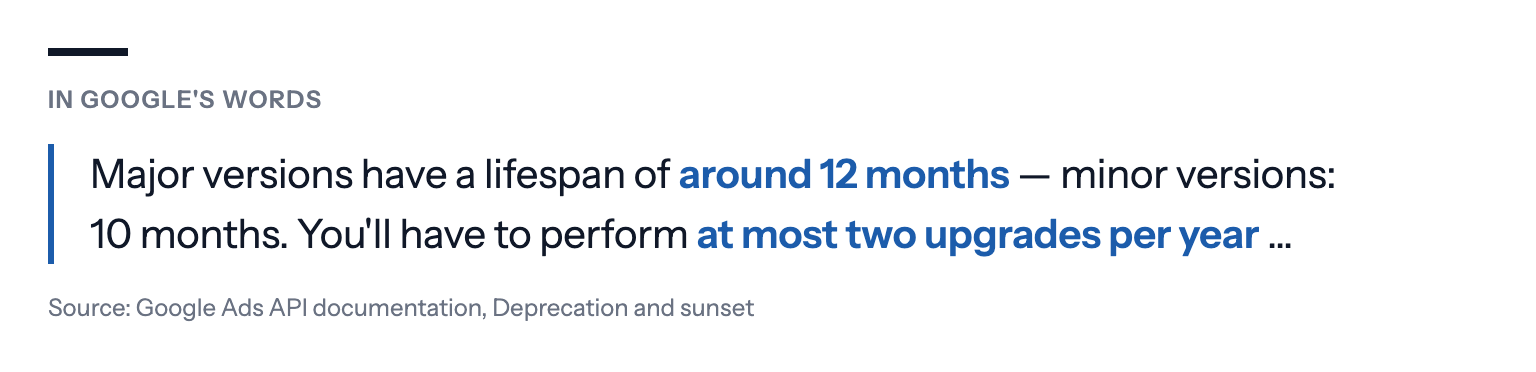
The plumbing changes too. Google retires each version of its API after about a year and expects up to two upgrades a year. A connector that worked in spring can stop working in autumn.
You have to check what the AI changed
An agent that makes changes needs someone who reads what it changed. Did it pause the campaign you meant? Did it add the negative keyword to the right place? Did the overnight run fail halfway?
A connected assistant has no shift. It acts when someone starts it, and it reports to whoever is in the chat. If nobody starts it on Friday, nobody notices on Friday that the purchase tag broke.
You have to give the AI a memory of past decisions
Running an account well depends on remembering why things are the way they are. This campaign was paused because its leads were junk. This keyword was blocked because it brought job seekers. This budget was raised for a test that ends on the 30th.
ChatGPT and Claude remember what you tell them about yourself. They don't keep a record of every change in your account and the reason for it, unless you build one. Without it, a fresh look at the numbers can undo a good decision for a bad reason.
You have to be the one who says no to bad ideas
Assistants are built to be helpful, and helpful often means agreeable. In the same test, shown a campaign with zero conversions after two weeks, ChatGPT gave what PPC Land's report called "an overly encouraging assessment".
Running an account well often means saying no: to the budget increase, to broad match, to the campaign idea that sounds exciting. If the agent won't, you have to.
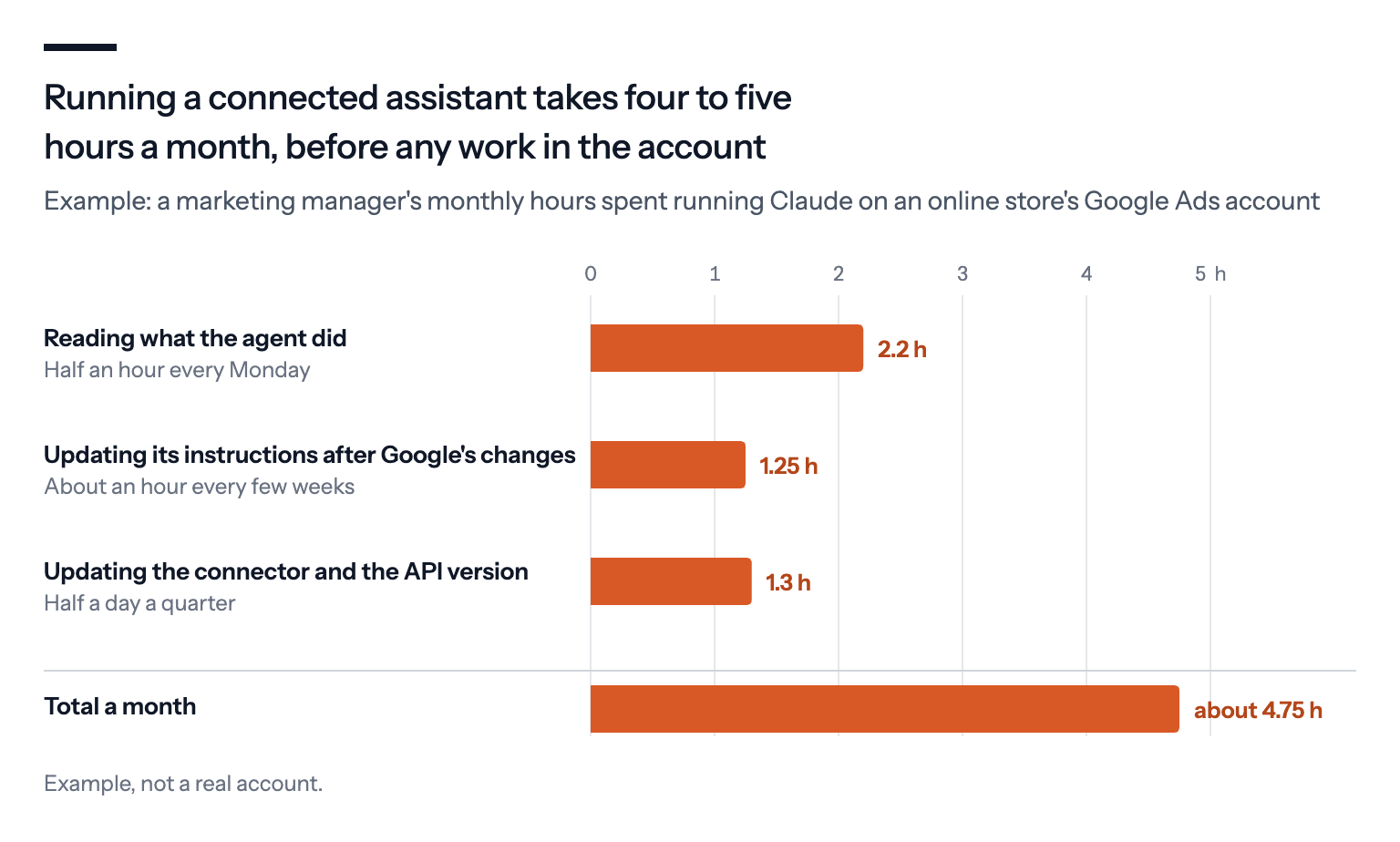
Example: the hours it takes to run Claude on a Google Ads account
(An illustration, not a real account.)
A marketing manager at an online store connects Claude to the company's Google Ads account on a Monday. It takes an afternoon. By Wednesday, it has found $400 of wasted searches and written better ads. It's a good week.
Then the routine settles in. Every Monday, half an hour to read what the agent did and why. Every few weeks, an hour to update its instructions after a Google change. Once a quarter, half a day when the connector needs an update or an API version is retired. And the evening in August when it raised the Target CPA on a budget-limited campaign, the week after Google changed how those campaigns bid.
None of that is unreasonable. But add it up, and the manager now spends four to five hours a month running the agent, on top of what they still do in the account. They've stopped doing Google Ads and started doing operations.
When connecting ChatGPT or Claude makes sense
For some people, building it is the point. A PPC specialist who enjoys tooling can build a very good agent around Claude, with read-only access, a change log and a habit of checking everything. That's real expertise, not a workaround.
The assistants are excellent analysts. Reading a search terms report, spotting patterns in a year of data, writing ad copy: for this, ChatGPT and Claude are among the best tools available, and read-only use carries little risk.
The tooling will get better. Google's connector may gain write access, and connectors will add more guardrails. Some of the setup and upkeep will shrink.
But even then, someone has to decide what the agent may do, keep it current and read what it did. That job doesn't disappear. It just moves.
How to use ChatGPT or Claude with Google Ads safely
Use ChatGPT or Claude as an analyst. Connect it read-only, ask it questions, and make the changes yourself.
If you give it write access, set the limits outside the chat. Budgets, conversion goals and campaign settings in Google Ads, where the agent can't move them without you.
Keep a decision log. Whatever does the work, write down why each larger change was made.
Check its claims about Google's rules. Ask for the source and the date. Google Ads changes faster than any assistant's training.
Count the hours honestly. If running the agent takes more time than it saves, it isn't saving you anything.
Why we built Bavian
This is the job we decided to take on. At Bavian, we go to work every day so businesses can let Autopilot run their Google Ads from A to Z, safely, and skip the setup, the instructions and the Monday checks. Bavian works inside a total daily budget you set and never raises it on its own, and we keep it up to date with Google's changes, so there are no instructions for you to rewrite. It shows every change it makes, with the reason, on the Agent page.