

Google's new Search model, Gemini 4 Hydrogen, answers long, specific questions better, for every searcher. For Google Ads, it's the search side of a shift from keywords to intent: exact and phrase match can't follow exploratory questions into AI answers, and tracking, product data and landing pages decide more. Here's what changed, and how to get an account ready.
Picture a search like this: waterproof walking boots for a three-day hike in Scotland in October, wide feet, under $200, not too heavy. Few Google Ads accounts have a keyword anywhere near it. Since 12 November 2026, Google Search has a model built to answer every part of it.
That day, Google put Gemini 4 Hydrogen into Google Search for all users worldwide. Robby Stein, VP of Product for Google Search, calls it "the biggest model upgrade to Search yet". The announcement doesn't mention ads.
For Google Ads advertisers, it still matters: it's the search side of a shift Google has been making in Google Ads for years, from matching the words people type to matching what they mean.
At Bavian, we follow changes like this one closely, because they move what happens in every account we run. Here's what changed, and what it asks of an account.
The short version
- Search now understands long, specific questions better, for everyone. Hydrogen handles multi-part, typo-filled and highly specific questions, and every searcher gets it, not only those who pay for Google's AI plans.
- Google Ads has been moving the same way. Broad match, AI Max, Shopping and Performance Max can match ads to what an exploratory question means. Exact and phrase match keywords can't.
- Ads inside AI Overviews and AI Mode run in the US and eleven other countries, in English. Not yet in the EU, and Google plans ads in AI Mode for the UK in the fourth quarter of 2026.
- The weight shifts from the keyword list to the inputs. Conversion tracking, product data, landing pages and exclusions decide more of what an account buys. A counting error now reaches more searches.
- The search terms report is getting harder to read. For AI Mode and AI Overviews, it shows Google's best approximation of the intent, not always what was typed.
What Google announced on 12 November 2026
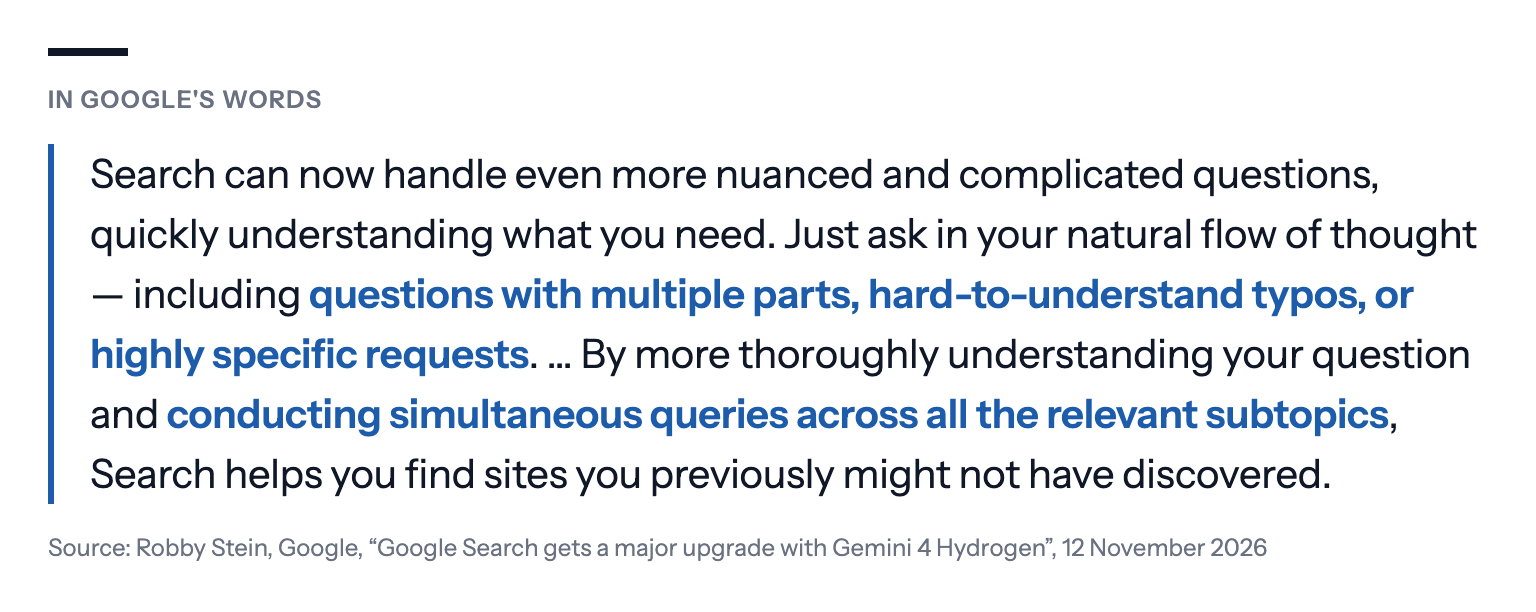
In Google's announcement, Stein lists four changes:
- Better understanding of intent. Search handles questions with several parts, hard-to-read typos or very specific requirements, and tries to answer each part.
- A wider query fan-out. Behind each answer, Search runs many searches at once on the subtopics of the question. With Hydrogen, Google says this connects people to a broader range of links, including sites they might not have found before.
- More visual answers. More images, structured responses, comparison tables and custom tools.
- Better answers in every language AI Mode supports.
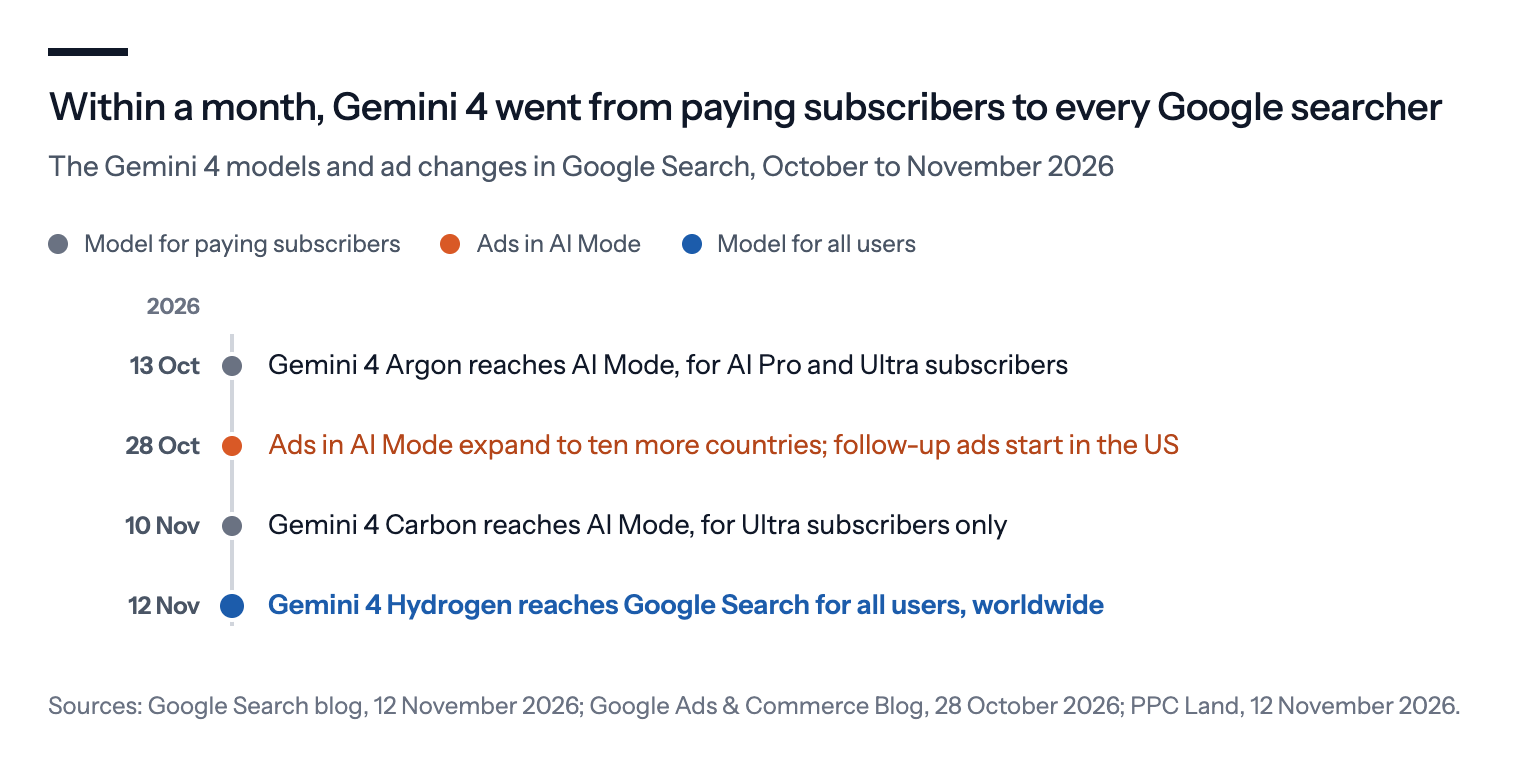
Hydrogen is the third Gemini 4 model to reach Search, and the first that every searcher gets. Gemini 4 Argon arrived on 13 October 2026 for people who pay for Google's AI Pro and Ultra plans, and Gemini 4 Carbon followed on 10 November 2026 for Ultra subscribers only, according to PPC Land. Hydrogen is Google's fast model. Google says it completes tasks 2.5 times faster than Gemini 3.8 Flash, the fast model before it, which helps explain why Google can run it on every search.
Why a Search model upgrade reaches Google Ads accounts
Nothing in the announcement changes the ad auction. The effect runs through how people search, and three things Google has already put in place.
Questions are getting longer. On 28 October 2026, Shashi Thakur, VP and GM of Google Search Ads, wrote that "In AI Mode, queries are, on average, three times longer than traditional searches." Hydrogen is built for exactly those questions, and the better Search answers them, the more of them people ask.
Ads follow the questions into the AI answers. In the countries where Google offers it, ads can appear inside AI Overviews and AI Mode, including on follow-up questions in AI Mode in the US. According to Google Ads Help, existing Search, Shopping and Performance Max campaigns take part automatically, in the same auction and at no extra charge. Advertisers can't target these placements on their own or opt out of them separately from Search, and the results are folded into normal campaign reports.
Google can also add "AI explainers" next to an ad, short texts written by its Gemini models that advertisers can't write, edit, approve or switch off.
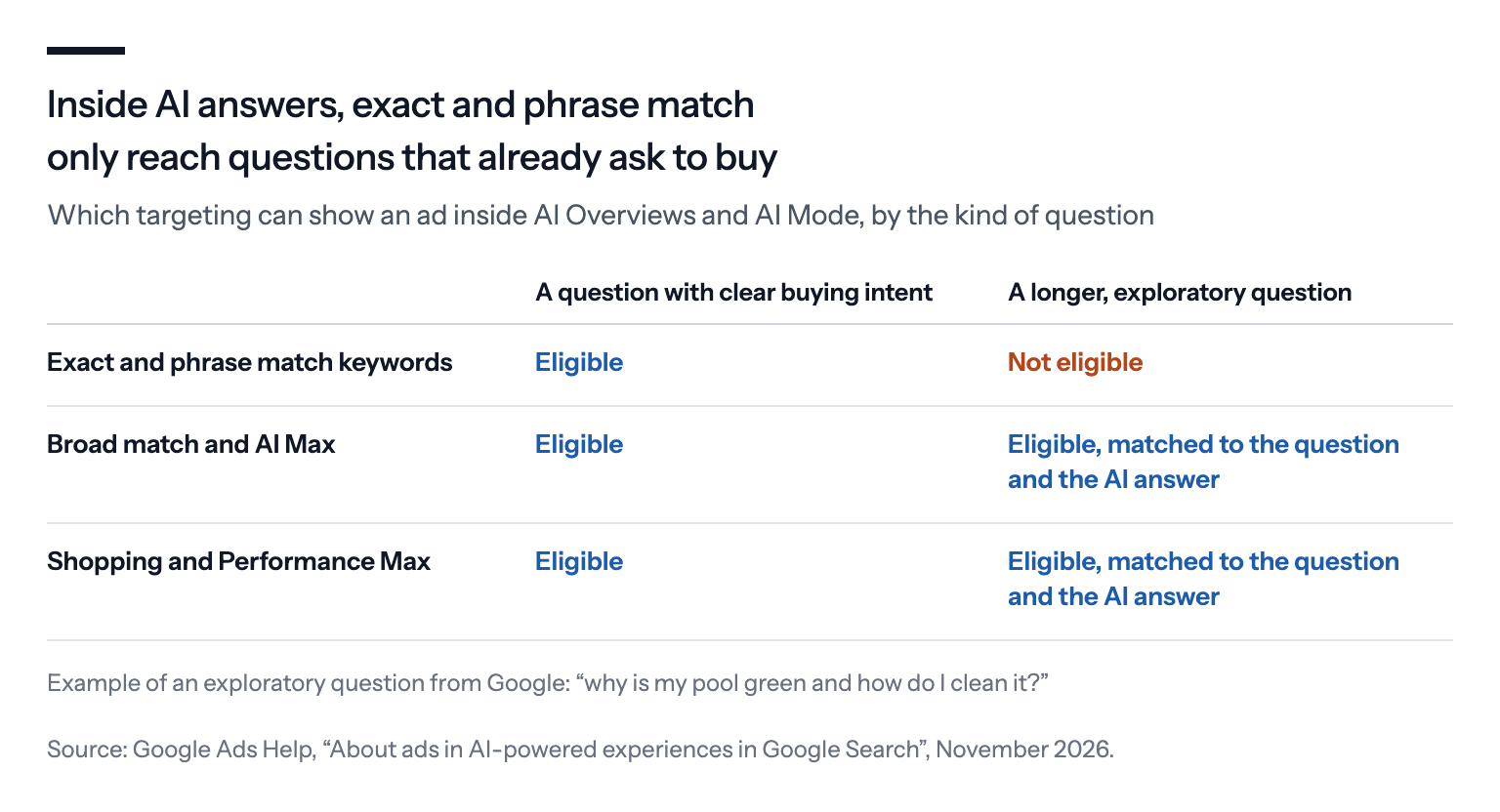
Only some keywords can follow. Google matches ads in AI answers in two ways: directly to a question that already shows clear commercial intent, or contextually to both a longer, exploratory question and the AI's answer to it. The same help page says broad match, AI Max, Shopping and Performance Max are eligible for both. Exact and phrase match keywords "aren't eligible for contextual matching on broader exploratory questions."
Frederick Vallaeys, who spent a decade as Google's AdWords Evangelist and is now co-founder of Optmyzr, a company that sells PPC management software, put it bluntly in May 2026: "The future PPC manager isn't a keyword picker. They're an intent engineer". His view is that of a vendor whose tools are built for the shift, but Google's own help pages point the same way.
The search terms report now shows Google's reading of a question
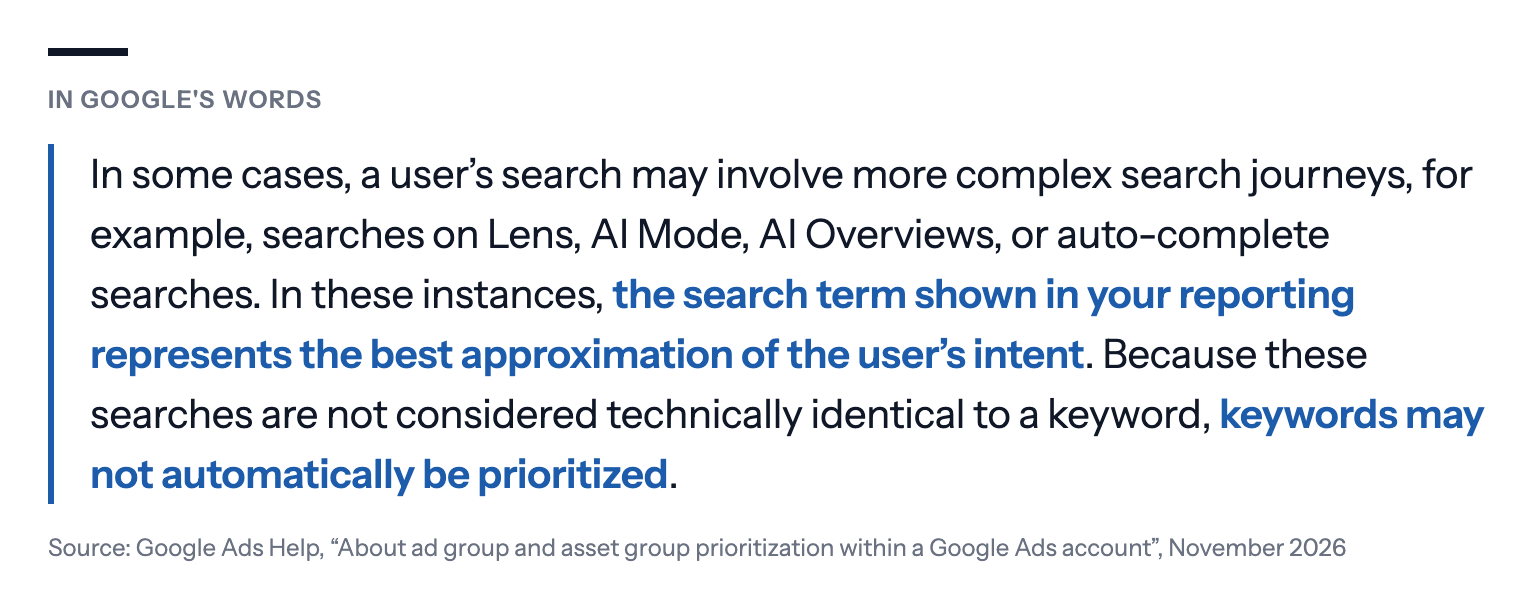
When the search is a long AI Mode conversation, a photo in Lens or an AI Overview, the search terms report may not show it as typed. Google's help page on ad group prioritisation says so directly.
Practitioners have noticed. "The search terms that you are seeing in your search query report might not be the search query at all," Anthony Higman, founder and CEO of ADSQUIRE, wrote on LinkedIn, as PPC Land reported in May 2026. Chris Chambers, head of paid search at Understory, warned that adding such an approximated term as a negative keyword can turn into "playing whack-a-mole with shadows": the reported term is blocked, while the same intent keeps arriving under a different one.
Hydrogen will make more searches look like that. The report remains the best view of what an account pays for, but it has to be read for meaning and patterns, not only for single strings.
What carries more weight in a Google Ads account now
As the keyword list steers less on its own, five other parts of the account steer more.
- Conversion tracking. Google's bidding learns from what an account counts as a conversion, and the broader the matching, the more searches a counting error reaches. In 100 Google Ads accounts Bavian audited, 98 had a problem with how conversions were counted.
- Product data. Comparison tables need comparable facts. For an online store, those come from Merchant Center: titles, prices, images and attributes such as size, material and colour. Google's help page asks for feeds that are "complete and fresh". A product Google can't describe precisely is hard to place next to others.
- Landing pages. Someone who asked a detailed question expects a page that answers it: the price, the delivery time, the size, the area served.
- Exclusions. Intent matching finds relevant searches nobody wrote as keywords, and some that don't fit. Negative keywords and brand exclusions remain the main controls, and Google confirms they still apply in AI Overviews and AI Mode.
- Budget. Wider matching usually means more places to spend. Google's AI is strong at bidding, and it works inside Google's business, as we described in Google's AI vs. an independent AI ad manager. What the account may spend in total stays the advertiser's decision.
Worked example: a sale counted twice, under broader matching
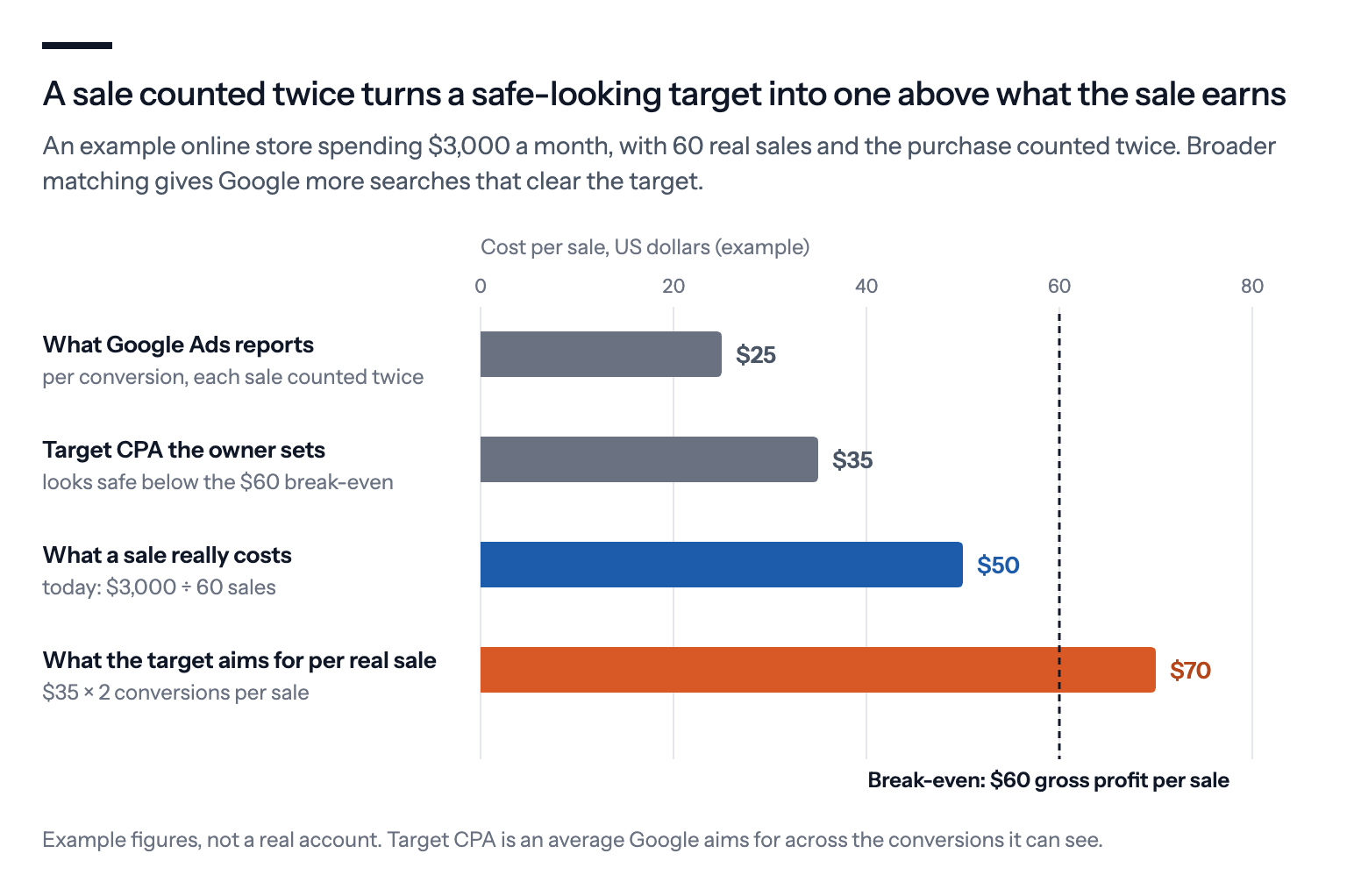
Take an online store that sells walking gear. The numbers are an example.
- It spends $3,000 a month on Google Ads and gets 60 real sales: $50 per sale.
- The purchase is counted twice, once by the Google tag and once by an imported conversion. Google Ads reports 120 conversions at $25 each.
- Each sale leaves $60 in gross profit, so the store breaks even at $60 per sale.
- The owner sets a Target CPA of $35, which looks safe next to the $60 break-even.
Because every sale counts twice, a $35 target tells Google to aim for about $70 per real sale on average, $10 more than the sale earns. With a short exact match list, the damage is limited to the searches on that list. With broad match or AI Max, and with Search answering more long questions, Google can find many more searches that clear the doubled target.
The error was the same before Hydrogen. Broader matching gives it more room.
When exact match and a tight keyword list still win
Intent matching isn't the right answer for every account, and Hydrogen doesn't change that.
- Exact match is still the most efficient match type in the large studies, as we covered in Broad, phrase or exact match in 2026. Broad pays off with Smart Bidding on conversion data you can trust, in a campaign that already converts and has run out of room.
- Accounts with few conversions have less to learn from. Chambers argues that large online stores have thousands of conversions a month for Smart Bidding to learn from, while lead generation accounts, especially B2B, often don't, and rely more on reading search terms. For them, a single word can separate a qualified lead from wasted budget.
- Brand searches don't need intent matching. Even Vallaeys, who argues that keywords are fading, advises building a dedicated brand campaign and locking it to exact match.
- Google decides more, and reports less. There's no separate segment for AI Overviews or AI Mode, and AI explainers can't be switched off. An advertiser who opens up matching gives Google more room in an area it shows less of.
- How fast search behaviour shifts is unknown. Google's post gives no figures on how many searches Hydrogen changes, and the November 2026 core update, which began on 10 November 2026, overlaps with the launch. Changes in an account's numbers over the coming weeks may have either cause.
For Google Ads advertisers in Europe and the UK
As of November 2026, Google Ads Help lists ads inside AI Overviews and AI Mode in the United States, Australia, Canada, India, Indonesia (AI Overviews only), Kenya, Malaysia, New Zealand, Nigeria, Pakistan (text ads only), the Philippines and Singapore, in English. No EU country is on the list. Google plans to bring ads in AI Mode to Brazil, Mexico and the United Kingdom in the fourth quarter of 2026. Ads above and below AI Overviews already run in every country where AI Overviews are available.
Hydrogen itself is in Search for all users. Searchers in the EU (European Union) will meet the same answers, and broad match, AI Max, Shopping and Performance Max already match their longer questions on the regular results page. When ads inside AI answers reach Europe, the accounts with trusted tracking, complete product data and pages that answer specific questions will be ready.
How to get a Google Ads account ready for longer questions
- Check what counts as a conversion. Make the purchase or the qualified lead the primary conversion, and make sure one sale is counted once. Everything else stays secondary.
- Read the search terms for meaning. Look for themes of intent that don't fit, not just single strings, and exclude the theme. A negative on one approximated term may not hold.
- Fill the product data. In Merchant Center, give every product the attributes a comparison needs: size, colour, material, gender and age group where they apply, and images of at least 500 x 500 pixels, the minimum from 31 January 2027.
- Make each landing page answer a specific question. The page a long question lands on should carry the details that question asked for.
- Open up matching where the data holds. Try broad match or AI Max in a campaign that converts on tracking you trust and has run out of room. Keep brand on exact match.
- Set the total budget yourself. Wider matching finds more places to spend; the ceiling should be yours.
Bavian and longer searches
Hydrogen is one of the changes Google makes to Search and Google Ads every week; when we counted a year of them, there were 280.
If you use Bavian with Autopilot on, it checks every day whether your conversion tracking can be trusted before it moves bidding, and goes through the last 30 days of search terms to block the ones that cost money without results or don't fit your business, so the weekly read-through is a step you can skip. For online stores whose Shopping or Performance Max campaigns Bavian runs, it also fills a colour, size, gender or age group that Google asks for and the feed leaves empty, from the product's own text. You start on the free plan, which analyses the account without changing anything.