

A Target CPA set below what conversions really cost makes Google bid on fewer clicks, and the budget goes unspent. Since 17 August 2026, the opposite mistake costs money too: a budget-limited campaign that used to beat a loose target now pays up to it. Set the target from what a conversion is worth to you, then check it against what it costs.
A campaign has a $100 daily budget and spends $60 of it. The owner raises the budget to $150, and it still spends $60. Nothing is broken: the campaign has a Target CPA, the cost per conversion Google is asked to aim for, set below what a conversion actually costs, and Google is doing exactly what it was told.
That's the old mistake. Since August, there's a new one in the other direction: campaigns whose targets were set generously, and which beat them for months because their budget held them back, now get conversions at a cost closer to the target.
Here's how both happen, and how to set a target that does what you want.
The short answer
- A Target CPA is an average Google aims for. Set it below what conversions cost today, and Google skips auctions it expects to be too expensive, so the campaign spends less and gets fewer conversions.
- Raising the budget doesn't fix that. The target, not the budget, is what holds the campaign back.
- Since 17 August 2026, campaigns that are "Limited by budget" bid towards their target rather than beating it. A loose target now means a higher cost per conversion.
- One agency's early numbers: across its Search campaigns, the cost per conversion rose 21% in the first week after the change, though its Target CPA Search campaigns stayed close to where they were.
- Work out what a conversion is worth to you, compare it with what it actually costs, and set the target between the two.
What a Target CPA does
With Target CPA, Google Ads sets a bid for each auction based on how likely that click is to lead to a conversion. Google's help page describes the target as "the average amount you'd like to pay for a conversion", and is plain about what happens when it's set too tight.
The target is an average, not a ceiling. Google will pay more for some conversions and less for others. But if you ask for an average well below what the market charges, the only way to get there is to bid on less: the cheapest, most certain searches, and not much else.
Google's own advice for Ad Grants accounts names the same cause when it lists why a budget isn't being spent: a bid strategy that is "too restrictive, e.g., a very low Target CPA", on its budgets and bidding page for nonprofits. The mechanics are the same in any account.
Why a bigger budget doesn't help
When a target is the limit, extra budget has nothing to buy. The campaign was already skipping the auctions it thought too expensive, and a bigger budget doesn't make them cheaper.
That's why a campaign that spends well under its budget is usually a target problem, not a budget problem. Our guide to Google's budget recommendations explains how "Limited by budget" differs.
What changed on 17 August
The opposite situation used to be harmless. A campaign that was "Limited by budget" and had a generous target could do better than the target, which Google calls overperforming, because the small budget went on the cheapest conversions.
Google changed that. Its page on changes to target-based bid strategies says that since 17 August 2026, campaigns "that are limited by budget and use a target-based bid strategy now perform more consistently toward your bid target, including when you make budget adjustments".
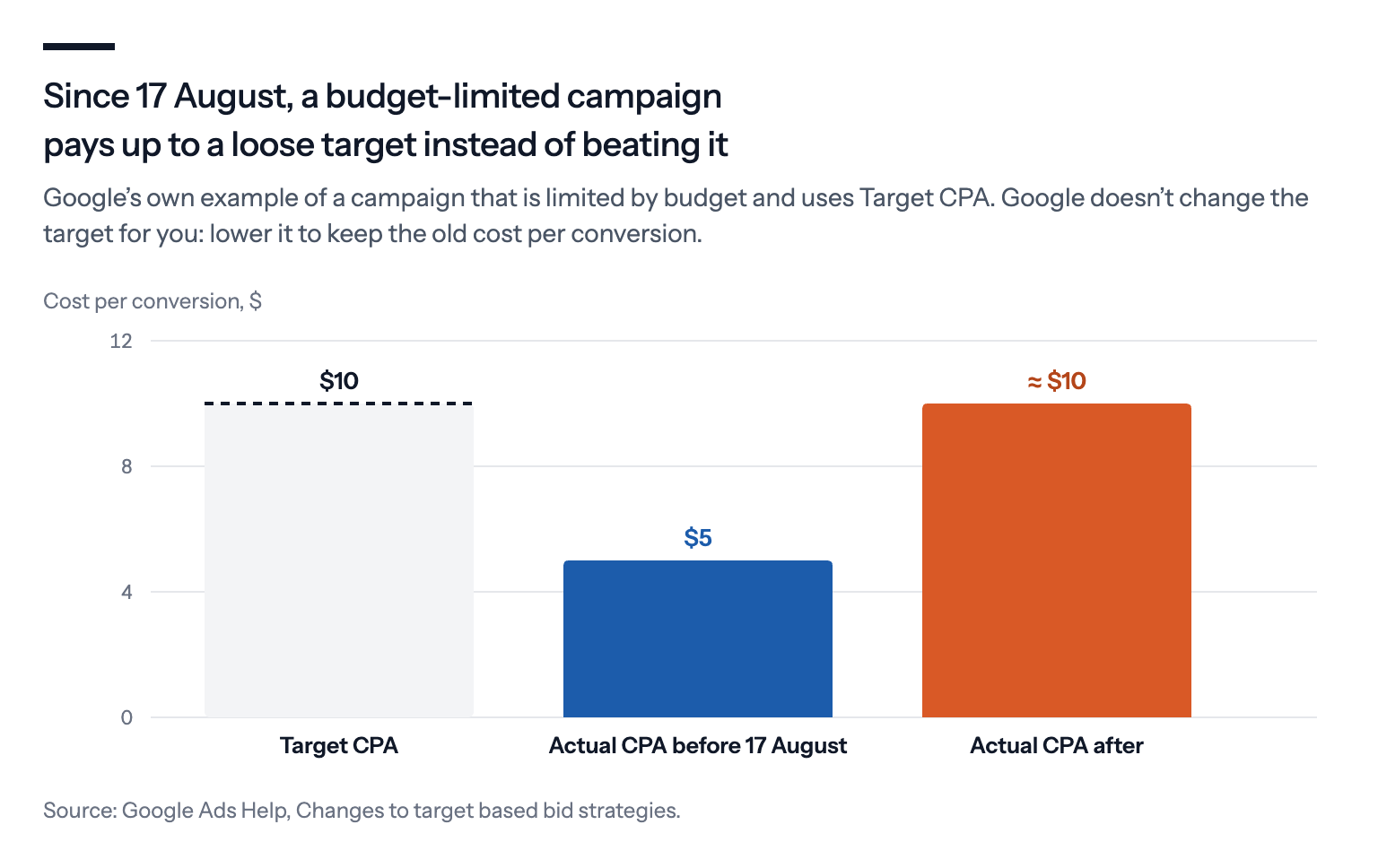
Google's own example: a campaign with a $10 Target CPA that had been achieving $5 "now delivers more closely to a $10 USD actual CPA". Google adds that it "won't automatically adjust your bidding targets or budgets". If you want to keep the $5, you have to lower the target yourself.
What the first weeks showed
Inna Zeyger, a vice president at the US agency Amsive, published an analysis of the first full week, comparing 17–23 August with the three weeks before across "millions of dollars in Google Ads spend across dozens of active advertisers".
In Search, the cost per click rose only 4%, but the conversion rate fell 15% and the cost per conversion rose 21%. Campaigns on Target ROAS got more clicks at a lower cost per click, but their return on ad spend fell 32%, while Target CPA Search campaigns "stayed relatively close to baseline".
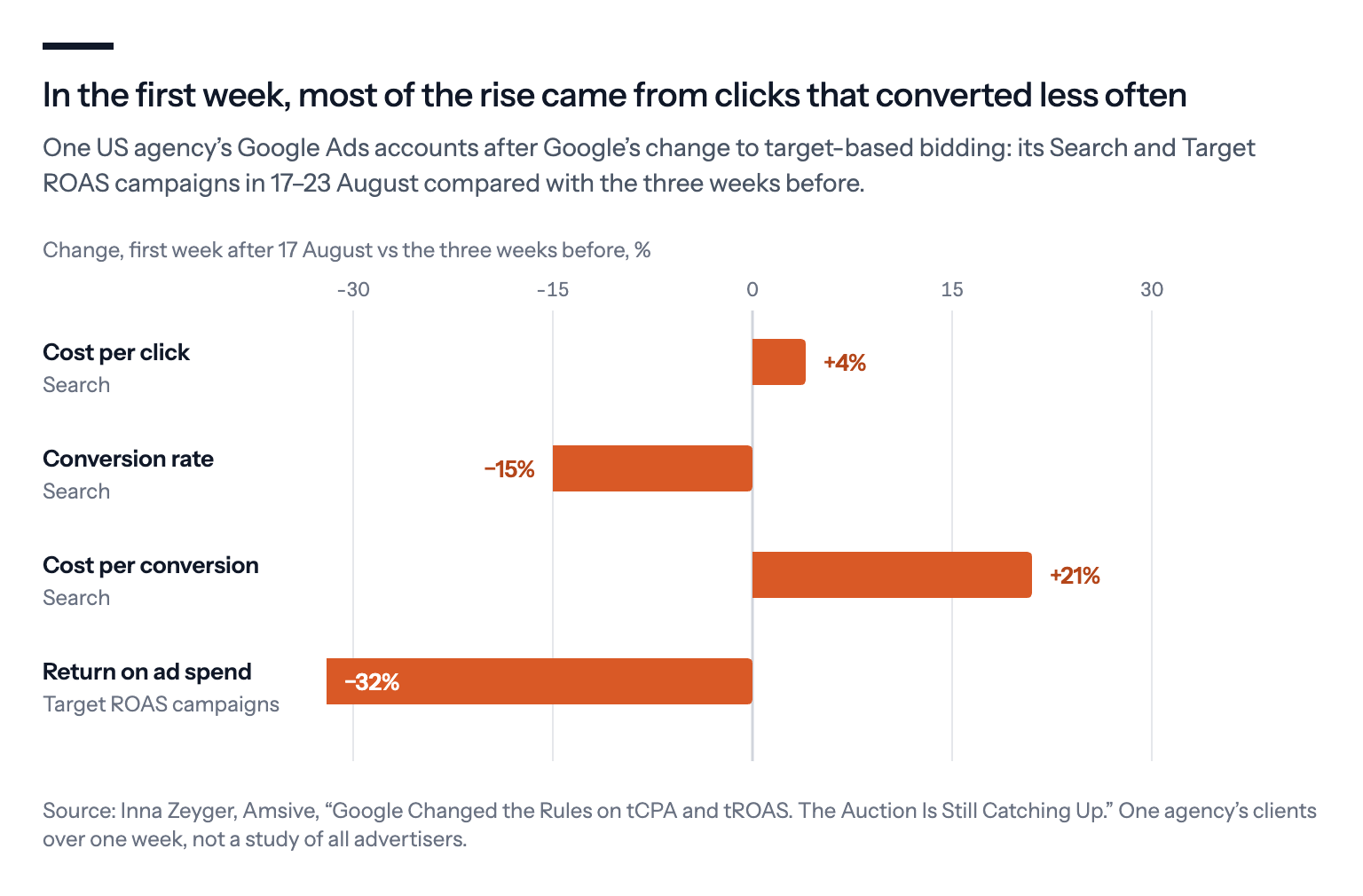
That's one agency's clients over one week, during a rollout Google only finished on 27 August, and the auction was still settling, as Zeyger notes. But in her numbers, most of the rise came from clicks that converted less often, not from higher click prices.
How to set a target that works
A good target sits between two numbers.
What a conversion is worth to you. For a lead, that's what a closed customer is worth multiplied by how many leads become customers. For a sale, it's the margin on an order. This is the ceiling: above it, conversions lose you money.
What a conversion costs today. Your actual cost per conversion over the last 30 days. Google's recommended target is built the same way: "the average CPA from the last 30 days, adjusted for any conversion delays".
If what it costs today is well below what it's worth, you can afford a target a bit above today's cost, which lets Google reach more conversions. Andrew Lolk of the Danish agency SavvyRevenue describes the same move with return-on-spend targets: his team typically loosens targets by about 20%, and "in 8 out of 10 cases" finds spend can grow meaningfully with "a minimal drop (if any)" in the business's overall return and margin, according to his agency's guide. That's his agency's experience, not a controlled test.
If what it costs is close to what it's worth, the target can't go much higher, and the answer is a better conversion rate, not a looser target.
A worked example
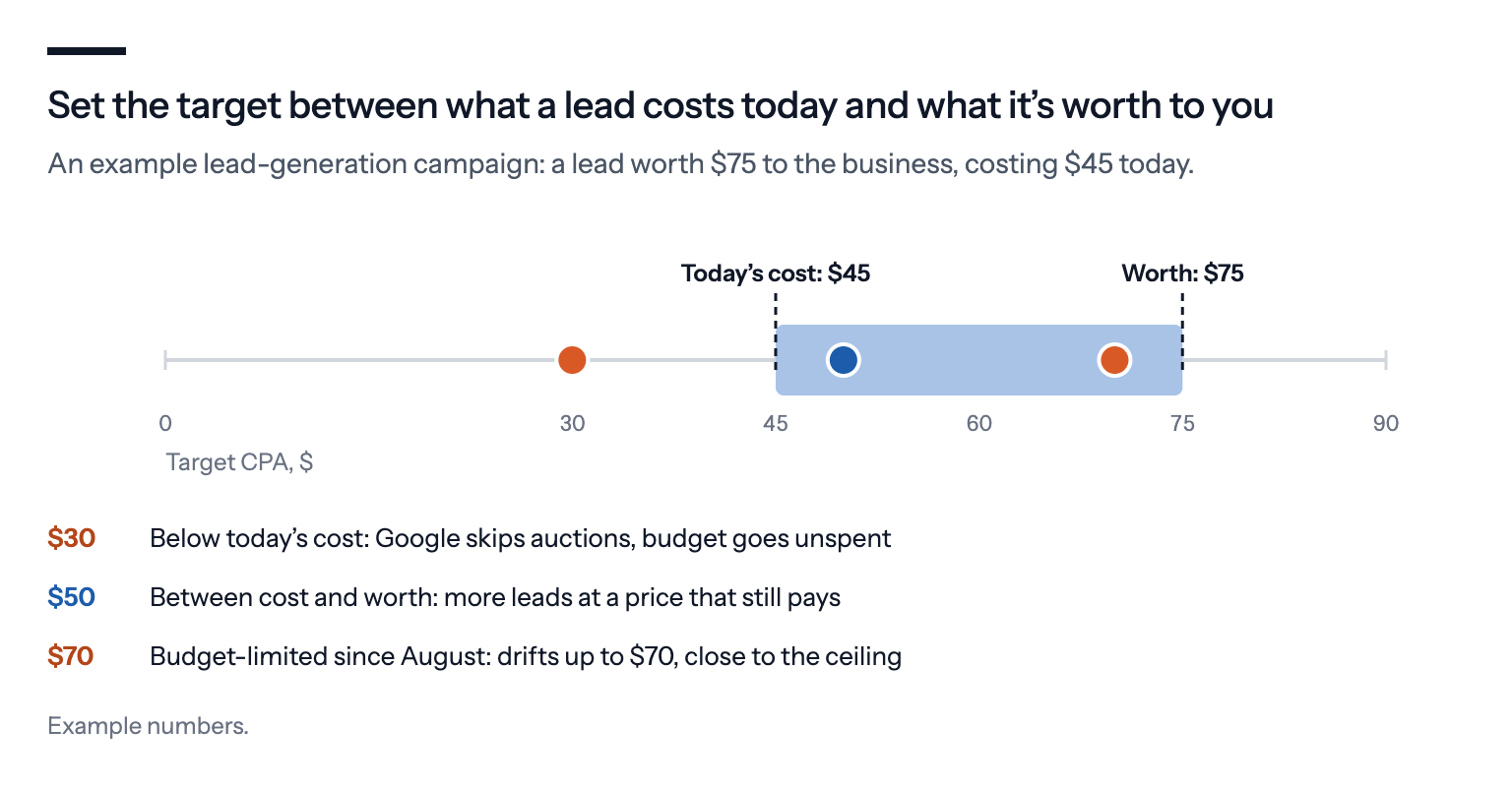
Take a fictional plumbing company. A booked job is worth $300 in margin, and about one in four leads becomes a booked job, so a lead is worth about $75.
Its Search campaign has a $100 daily budget and a Target CPA of $30, set at launch. Leads actually cost $45, and the campaign spends $60 a day. Raising the budget changes nothing.
The owner sets the target to $50: below the $75 a lead is worth, a little above today's $45. Over the next weeks the campaign spends closer to its budget, and leads cost about $48 on average. More leads, at a price that still leaves $27 of margin per lead.
Now the reverse. A second campaign, "Limited by budget", has a $70 target but has been getting leads at $45. Since August, it drifts towards $70, close to what a lead is worth. Lowering the target to $45 keeps the old cost per lead, and raising the budget is the way to buy more leads.
Where this falls short
Value isn't always known. Many businesses don't know what a lead is worth. A rough number, from last quarter's leads and customers, is better than none, but it is rough.
Lead quality varies. A looser target can bring in leads that convert less often to customers. Track what happens after the form, or the cost per lead will mislead you.
Small accounts get noisy numbers. With a few conversions a week, a 30-day average cost per conversion can swing a lot. Use a longer period before moving the target.
Targets change slowly. Google says performance converges to a new target over one to two conversion cycles, and advises against several target changes within one cycle. Change it, then wait.
What we'd do
Compare the target with what conversions cost. If the target is well below your actual cost per conversion and the budget isn't being spent, the target is the limit.
Write down what a conversion is worth. For leads, value per customer times the share of leads that become customers. For sales, the margin on an average order.
Set the target between cost and worth. Close to today's cost if you want efficiency, closer to worth if you want volume.
Check budget-limited campaigns that beat their target. Since August, they drift towards the target. Lower it to keep the old cost, or raise the budget at the target you're happy with.
Move one step, then wait a conversion cycle. Our guide to ROAS targets covers how big those steps should be.
If you use Bavian, it decides each campaign's bidding, with or without a target, except on shared (portfolio) strategies, unless you take over on the Bidding page, where you can enter your own cost per conversion. Removing a target, or switching to a strategy without one, waits for your yes.